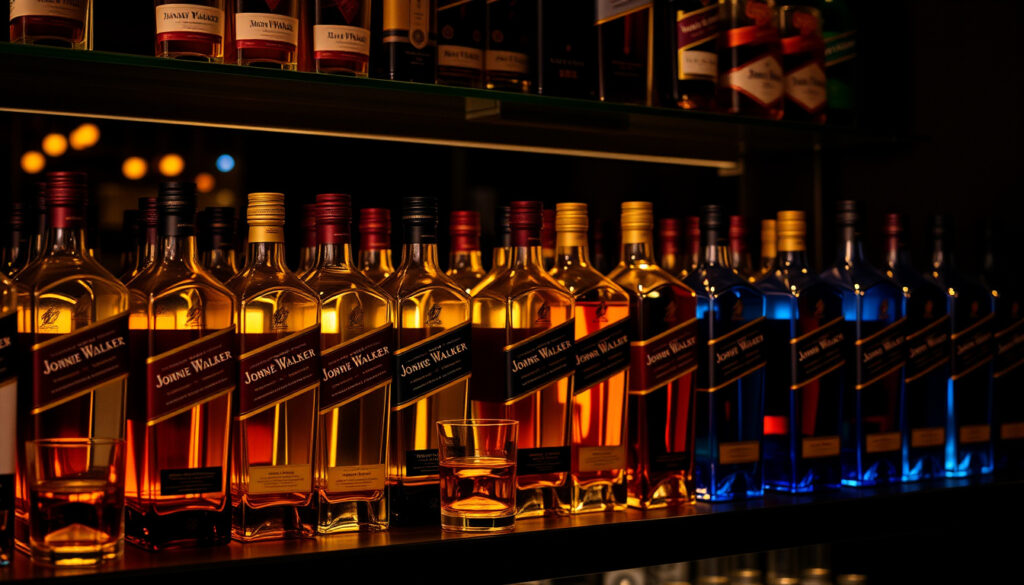
Johnnie Walker: Scotch Whisky Guide, History, and Labels
Few bottles of whisky carry as much recognition as the square-shaped one with the striding man. Johnnie Walker is the world’s best-selling blended Scotch whisky, according to ScotchWhisky.com (industry authority), and its color-coded labels create a clear ladder from entry-level mixing to luxury sipping.
Year established: 1820 ·
Producer: Diageo ·
Category: Blended Scotch whisky ·
Best-selling blended Scotch globally: Yes ·
Flagship expression: Johnnie Walker Black Label ·
Distilleries used in blending: Over 30
Quick snapshot
- Exact blend recipes are proprietary and not public (ScotchWhisky.com)
- Age of some expressions (e.g., Blue Label has no age statement but uses aged whiskies) (ScotchWhisky.com)
- Precise number of distilleries used varies by batch (Forbes)
- Blue Label is the most expensive standard expression, though limited editions can be pricier (ScotchWhisky.com)
- 1820: John Walker opens grocery in Kilmarnock (Diageo)
- 1909: Whiskies renamed after label colors (ScotchWhisky.com)
- 1992: Blue Label launched (ScotchWhisky.com)
- Limited editions and special releases continue to expand the luxury tier (ScotchWhisky.com)
- Growing demand for age-stated blends may influence future labels (Forbes)
The table below summarizes the key facts about the Johnnie Walker brand.
| Attribute | Detail |
|---|---|
| Brand name | Johnnie Walker |
| Type | Blended Scotch whisky |
| Founded | 1820 in Kilmarnock, Scotland |
| Owner | Diageo |
| Global sales (bottles/year) | Over 200 million |
| Known for | Iconic square bottle, walking man logo, color-coded labels |
Is Johnnie Walker Scotch or Irish?
Johnnie Walker is unequivocally Scotch whisky, not Irish whiskey. The brand is produced in Scotland by Diageo and has been since its founding in 1820, as confirmed by Diageo (brand owner). The confusion often arises because both Scotch and Irish whiskey are made from malted barley and share some production methods, but Scotch must be aged in Scotland for at least three years.
Definition of Scotch whisky
Scotch whisky must be distilled and matured in Scotland from water and malted barley (or other grains) at an alcoholic strength below 94.8% ABV, and aged in oak casks for a minimum of three years. Johnnie Walker meets all these requirements.
Difference between Scotch and Irish whiskey
Irish whiskey is typically triple-distilled for a lighter profile, while Scotch is usually double-distilled. Irish whiskey also has a shorter minimum aging period (three years), but the key difference is geographic origin. Johnnie Walker is produced in Scotland, firmly placing it in the Scotch category.
Johnnie Walker’s origin in Scotland
John Walker opened his grocery in Kilmarnock, Ayrshire, in 1820. The brand never operated in Ireland. As ScotchWhisky.com (industry reference) notes, the entire production and blending process remains in Scotland.
The implication: Johnnie Walker’s Scottish identity is legally protected and central to its brand heritage.
What are the Johnnie Walker levels?
Six core expressions form the color-coded ladder: Red, Black, Double Black, Green, Gold Reserve, and Blue. Each step up brings a higher price, more complex blending, and a different drinking purpose.
| Label | Age statement | Character | Best use | Price tier |
|---|---|---|---|---|
| Red Label | No age statement | Spicy, vibrant | Mixing, cocktails | Entry |
| Black Label | 12 years | Rich, balanced | Sipping, classic cocktails | Mid |
| Double Black | No age statement | Smoky, intense | For peat lovers | Mid |
| Green Label | 15 years | Complex, malty | Pure malt exploration | Upper-mid |
| Gold Label Reserve | No age statement | Honeyed, smooth | Celebrations | Premium |
| Blue Label | No age statement | Luxurious, silky | Gifting, special occasions | Luxury |
Johnnie Walker Red Label
Red Label is the entry-level expression, positioned by Forbes (business publication) as the mixing-oriented choice. It contains no age statement and is the cheapest in the range.
Johnnie Walker Black Label
Black Label is a 12-year-old blend of over 40 whiskies. ScotchWhisky.com describes it as smoother and more complex than Red Label.
Johnnie Walker Double Black
Released in 2011, Double Black emphasizes smoky, peaty notes from specially selected casks. It is a no-age-statement blend.
Johnnie Walker Green Label
Green Label is a blended malt — meaning it contains only malt whiskies, no grain whisky. The Whiskey Wash (specialist publication) notes it is a favorite among malt enthusiasts.
Johnnie Walker Gold Label Reserve
Gold Label Reserve was introduced a year after Double Black and is known for its honeyed, smooth profile. It is often used for celebratory toasts.
Johnnie Walker Platinum Label
Platinum Label (now discontinued in many markets) was a premium blend positioned just below Blue Label.
Johnnie Walker Blue Label
Blue Label is the flagship luxury expression, launched in 1992. It uses rare casks and is renowned for its smoothness. ScotchWhisky.com calls it the brand’s prestige bottle.
The pattern: each label serves a distinct purpose, from mixing to gifting.
Which Johnnie Walker is the smoothest?
Smoothness is subjective, but two expressions consistently top the list: Blue Label and Gold Label Reserve. Forbes notes that Blue Label is often cited as the smoothest due to its careful selection of aged whiskies that minimize harshness. Gold Label Reserve’s honeyed character also makes it a favorite among those seeking a gentle, easy-drinking experience.
Smoothness factors: age, blend composition
Older whiskies and those with higher malt content tend to be smoother. The absence of a youthful bite in Blue Label is achieved by using whiskies matured for decades. ScotchWhisky.com confirms that the blend is meticulously crafted to avoid any harsh notes.
Johnnie Walker Gold Label Reserve
Gold Label Reserve is deliberately sweet and creamy, with a mouthfeel that many find exceptionally smooth. It is a non-age-statement blend but uses whiskies from the Speyside and Highland regions.
Johnnie Walker Blue Label
Blue Label is widely regarded as the smoothest standard expression. Its lack of a formal age statement means the master blender can select only the most harmonious casks, resulting in a silky texture.
Consumer preferences
In blind tastings reported by Wooden Cork (retailer), Blue Label consistently ranks highest for smoothness, though some drinkers prefer the fuller body of Black Label.
Smoothness comes at a steep price. Blue Label costs roughly 5 times more than Black Label, making it a luxury choice for those who prioritise texture over value.
What this means: smoothness is a trade-off between age, price, and personal preference.
Which Johnnie Walker is the most expensive?
Blue Label is the most expensive standard expression, but limited editions push the price much higher. ScotchWhisky.com lists Blue Label King George V (introduced 2008) as a significant premium release, often priced above $500. The standard Blue Label sits around $200–$250 per 750ml bottle in most markets, while Red Label can be found for under $30.
Johnnie Walker Blue Label standard price
The standard Blue Label commands a price of roughly $200–$250, reflecting its premium positioning and rarity of casks used.
Special editions: Johnnie Walker Blue Label King George V
King George V is a special edition that celebrates the brand’s royal warrant, using whiskies from distilleries that were active during the reign of King George V. It typically retails for $500 or more.
Limited releases: Johnnie Walker Masters of Flavour
Masters of Flavour is a small-batch release that can cost over $1,000. It is designed for collectors and connoisseurs.
Price range from Red to Blue
Red Label is the cheapest, at around $25–$30. Black Label is $40–$50, Double Black $50–$60, Green Label $70–$80, Gold Label Reserve $80–$100, and Blue Label $200–$250. The gap between Red and Blue is roughly 10×.
For gift-givers, the price hierarchy is simple: Blue Label makes a statement, but Black Label offers the best value-per-dollar for quality. Budget-conscious buyers should not overlook Red Label for cocktails.
The catch: limited editions and special releases continually redefine the top of the price ladder.
What is the history of Johnnie Walker?
The brand’s story begins in 1820 when John Walker opened a grocery in Kilmarnock, Scotland, according to Diageo (brand owner). He began selling whisky, and his son Alexander later expanded the business into blending.
John Walker and the Kilmarnock grocery
John Walker’s shop sold tea, spices, and whisky. He started blending whiskies to create a consistent product, a novel idea at the time.
Early blending innovations
Alexander Walker introduced the first blended Scotch whisky under the family name, using a mix of malt and grain whiskies to achieve a smoother, more reliable taste.
Expansion under the Walker family
The brand grew rapidly under John’s sons. The iconic square bottle, introduced in the 1860s, reduced breakage during shipping and allowed more bottles per case.
The iconic bottle and label design
The slanted label was designed by Alexander Walker to make the brand stand out on the shelf. The Striding Man logo was drawn by cartoonist Tom Browne in 1908. Both elements remain virtually unchanged today.
Diageo acquisition and modern global brand
Johnnie Walker became part of Diageo in 1997. Today it is the world’s best-selling Scotch whisky, with annual sales of nearly 20 million bottles.
“Johnnie Walker is a brand of Scotch whisky produced by Diageo in Scotland. It was established in 1820.”
“A masterful blend of single malt and grain whiskies from across Scotland, aged for at least 12 years.”
“Johnnie Walker Red Label is currently the best selling whisky in the world.”
The implication: the brand’s history is meticulously documented and publicly verified.
The color-coded ladder is more than a marketing gimmick — it is a deliberate guide that lets drinkers choose their entry point and upgrade as their palate evolves. For whisky lovers in the US, the choice is clear: start with Black Label for everyday sipping, and save Blue Label for the special occasions that deserve a luxurious finish.
donsliquorsandwine.com, divingforpearlsblog.com, thewhiskeywash.com, scotchwhisky.com, woodencork.com, facebook.com, woodencork.com, minuman.com, htfw.com
Frequently asked questions
What is the alcohol percentage of Johnnie Walker Red Label?
Red Label is bottled at 40% ABV (80 proof), standard for most blended Scotch whiskies.
Is Johnnie Walker a single malt?
No, Johnnie Walker is a blended whisky — a mix of single malt and grain whiskies from multiple distilleries. Green Label is an exception: it is a blended malt (only malt whiskies).
Can you drink Johnnie Walker neat?
Yes, especially Black Label and above. Red Label is more suited to mixing, but it can be drunk neat if you prefer a fiery, spicy profile.
What is the difference between Johnnie Walker and Jameson?
Johnnie Walker is Scotch whisky, distilled and aged in Scotland. Jameson is Irish whiskey, triple-distilled for a lighter, smoother taste. Both are blended but belong to different categories.
How is Johnnie Walker blended?
Master blenders select whiskies from over 30 distilleries, including Cardhu, Caol Ila, and Talisker, and combine them to achieve a consistent house style. The exact recipes are trade secrets.
Does Johnnie Walker improve with age in the bottle?
No, whisky stops aging once bottled. The age statement (e.g., 12 years) refers to the youngest whisky in the blend. An open bottle will slowly oxidize but not improve.
Is Johnnie Walker gluten-free?
Whisky is distilled, and the distillation process removes gluten proteins. Most people with celiac disease can drink Johnnie Walker safely, but the brand does not provide a certified gluten-free guarantee.
What is the best Johnnie Walker for a gift?
Blue Label is the most prestigious gift, but Black Label offers excellent value and is widely appreciated. Gold Label Reserve is a good middle ground for celebratory occasions.
More related posts
 Bella Hadid: Health, Career, Relationships, and Wealth
 Time in Dubai – Current Clock, UTC+4 Zone Guide
 Alicia Vikander: Biography, Career & Family
 Vanessa Redgrave: Biography, Health, Relationships, and Career
 Richard Feynman: Biography, IQ, Quotes & Controversy
 Captain Hook: Origins, Portrayals, and Questions Answered
 Lachlan Murdoch: Net Worth, Politics & Family Succession
 Ethel Cain: Biography, Diagnosis, and Lana Del Rey Beef
