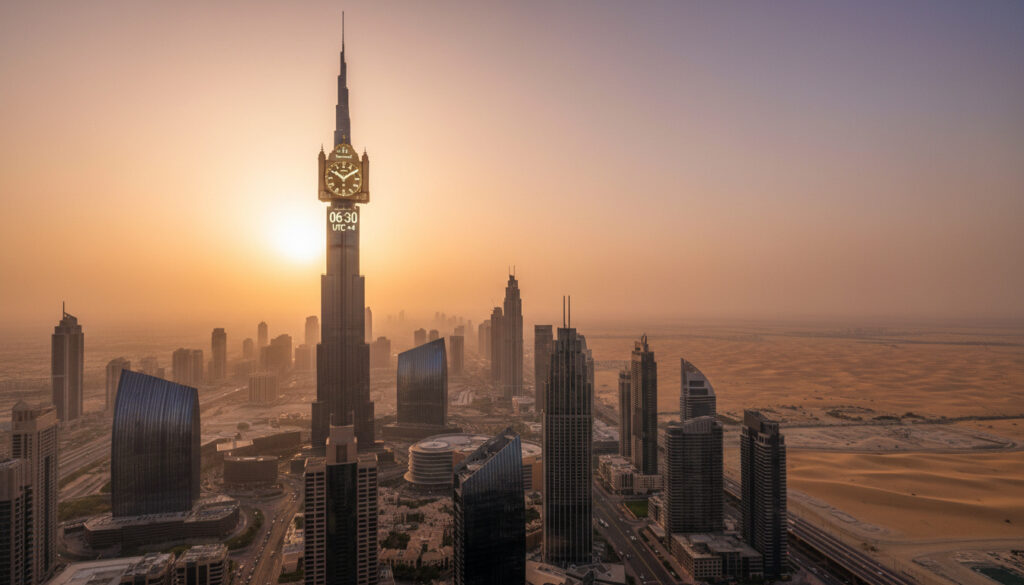
Time in Dubai – Current Clock, UTC+4 Zone Guide
Dubai currently operates under Gulf Standard Time (GST), maintaining a fixed offset of UTC+4 throughout the year. At 5:00 AM UTC, clocks in the emirate read 9:00 AM GST, with daylight typically breaking around 6:10 AM and ending near 6:35 PM depending on seasonal solar positioning. Unlike many financial centers worldwide, Dubai does not observe daylight saving time, ensuring consistent temporal alignment for business and travel coordination.
The official IANA time zone identifier for the region is Asia/Dubai, a classification shared across all seven emirates of the United Arab Emirates. This standardization eliminates internal time discrepancies within the country, simplifying domestic scheduling and telecommunications. For international callers and global enterprises, the fixed UTC+4 offset provides a reliable constant unaffected by the biannual clock adjustments common in Europe and North America.
Travelers frequently query Dubai’s local time when planning meetings across continents. The emirate sits four hours ahead of Coordinated Universal Time year-round, creating specific differentials with major business hubs: three hours ahead of London and eight to nine hours ahead of New York depending on seasonal shifts in those locations.
What Time Is It in Dubai Right Now?
Precise local time in Dubai remains constant relative to UTC, unaffected by seasonal variations. The emirate’s clocks align with solar positioning that places sunrise near 6:10 AM GST and sunset near 6:35 PM GST during equinoctial periods, yielding approximately 12 hours and 25 minutes of daylight.
Key operational facts define the current temporal environment:
- Dubai maintains UTC+4 year-round without seasonal clock adjustments.
- The timezone aligns identically with Abu Dhabi and all seven UAE emirates.
- Solar noon occurs roughly at 12:23 PM GST, varying slightly by date.
- Standard business hours initiate between 8:00 and 9:00 AM GST.
- Travelers from London face a three-hour deficit; New York visitors face eight to nine hours.
- Mobile applications provide real-time conversion utilities for coordination.
Long-distance financial transactions require particular attention to these offsets. Those monitoring international markets might reference the AUD to IDR Today – Current Exchange Rate Guide when coordinating trades across Asian and Australian time zones relative to Dubai.
| Fact | Detail |
|---|---|
| Official Name | Gulf Standard Time (GST) |
| UTC Offset | +04:00 |
| IANA Identifier | Asia/Dubai |
| Daylight Saving | Not observed |
| Regional Coverage | Dubai and all UAE cities |
| Sunrise (sample) | ~6:10 AM GST |
| Sunset (sample) | ~6:35 PM GST |
| Standard Business Start | 8:00–9:00 AM GST |
| Solar Noon | ~12:23 PM GST |
| Time Difference (London) | +3 hours |
What Time Zone Is Dubai In?
Dubai falls within the Gulf Standard Time zone, designated internationally as UTC+4. This classification places the emirate four hours ahead of Coordinated Universal Time, creating a temporal bracket that bridges Asian and European business hours.
The Asia/Dubai Designation
The IANA Time Zone Database assigns Dubai the identifier “Asia/Dubai,” recognizing the emirate’s longitudinal position and administrative timekeeping practices. This designation encompasses the entire UAE, ensuring unified timekeeping from Ras Al Khaimah to Fujairah.
Geographic positioning determines the UTC+4 offset. Dubai sits at approximately 55 degrees east longitude, placing it naturally within the fourth time zone east of the Prime Meridian. Historical adoption of this standard dates to 1972, when the UAE established consistent national timekeeping.
All UAE cities including Abu Dhabi, Sharjah, and Al Ain maintain identical time to Dubai. This uniformity eliminates the need for domestic time conversion when traveling within the federation.
Digital systems reference this zone through the standard offset notation +04:00. Database administrators and software developers utilize this identifier when configuring servers or scheduling applications for the region.
Offset Stability
The fixed nature of Dubai’s time zone distinguishes it from regions with fractional or variable offsets. Unlike India (UTC+5:30) or Iran (UTC+3:30), Dubai maintains a whole-hour difference from UTC, simplifying mental arithmetic for international coordination.
Time.is provides atomic clock-synchronized readings for the emirate, while 24TimeZones offers detailed offset documentation.
Does Dubai Observe Daylight Saving Time?
Dubai does not implement daylight saving time in 2026 or any projected year. The emirate maintains consistent GST (UTC+4) throughout all seasons, rejecting the biannual clock adjustments practiced in North America and Europe.
Current Policy and Historical Context
The United Arab Emirates abandoned daylight saving transitions in 1988, establishing permanent standard time. This decision followed decades of experimental adjustments that proved disruptive to business and religious schedules tied to solar positioning.
Historical records indicate the UAE adopted UTC+4 in 1972 upon federation formation. The subsequent 1988 resolution fixed this offset permanently, recognizing that seasonal clock changes created confusion for international trade and domestic prayer time calculations.
Implications for Travelers
Visitors from regions observing DST must manually adjust their expectations during summer months. While London shifts from GMT to BST (UTC+1), Dubai remains fixed, effectively reducing the time difference from four hours to three hours during British Summer Time.
This temporal stability benefits long-term planning. Calendar appointments maintain consistent offsets year-round, unlike conferences scheduled between New York and Dubai, where the differential contracts and expands by one hour depending on the season.
Dubai Time Differences with Major Cities
Dubai sits ahead of most Western financial centers and behind East Asian capitals. Understanding these differentials proves essential for international business coordination and personal communication.
European and UK Comparisons
London operates three hours behind Dubai during standard time (GMT) and four hours behind during British Summer Time (BST). This proximity facilitates same-day business communication, with overlapping office hours typically occurring between 9:00 AM and 1:00 PM GMT.
Paris, Berlin, and Rome maintain similar differentials, generally trailing Dubai by two to three hours depending on European DST implementation. The World Time Buddy converter provides visual grid comparisons for these relationships.
North American Offsets
New York falls eight hours behind Dubai during Eastern Standard Time (EST) and nine hours behind during Eastern Daylight Time (EDT). This substantial gap reduces real-time business windows to early morning or late evening hours for both locations.
Travelers arriving from London typically require minimal circadian adjustment due to the three-hour difference. Those arriving from New York face more significant adaptation periods, with medical guidelines suggesting one to two days of recovery for every hour of time zone shift.
Los Angeles and the Pacific coast extend this differential to 11-12 hours, creating nearly opposite daylight schedules. Morning meetings in Dubai correspond to late evening hours in California.
Asian Regional Alignment
Singapore and Dubai share no time difference, both operating at UTC+8 and UTC+4 respectively—creating a four-hour gap. Tokyo sits five hours ahead, while Mumbai (UTC+5:30) maintains a 1.5-hour lead over the emirate.
These proximities facilitate Asian market access while maintaining European afternoon connections, positioning Dubai as a temporal bridge between continents.
While clock time remains fixed, Islamic prayer times in Dubai shift daily based on solar positioning. Fajr, Dhuhr, Asr, Maghrib, and Isha times vary throughout the year despite constant GST, requiring consultation of local prayer schedules or specialized applications.
How Did Dubai’s Timekeeping Evolve?
The emirate’s temporal standards emerged through federal unification and subsequent technological standardization. This progression established the current reliable system.
- 1972: The United Arab Emirates adopts UTC+4 as the national standard upon federation formation, replacing disparate local timekeeping practices.
- 1988: Federal authorities establish permanent standard time, formally discontinuing daylight saving time observations that had created seasonal disruption.
- 2000s: IANA formalizes the Asia/Dubai identifier in the Time Zone Database, ensuring global software compatibility.
- Present: Atomic clock synchronization and network time protocol (NTP) servers provide microsecond accuracy to financial and telecommunications infrastructure.
Documentation from Logwork confirms these historical markers, while SavvyTime tracks current offsets against this established history.
What Is Certain About Dubai Time?
Official records establish clear parameters regarding Dubai’s timekeeping, though some operational details remain context-dependent.
- GST (UTC+4) is the permanent, year-round standard
- No daylight saving time is observed currently or planned
- All UAE cities share identical time with Dubai
- IANA identifier Asia/Dubai is authoritative
- UTC offset remains fixed at +04:00
- Specific business opening hours vary by sector and company
- Exact prayer times shift daily with solar positioning
- Seasonal daylight duration affects operational rhythms despite fixed clocks
- Future policy changes regarding timekeeping remain unspecified
Authorities confirm through Time.gov and IANA databases that the emirate maintains strict adherence to the established UTC+4 standard.
Why Does Dubai Use Gulf Standard Time?
Geographic positioning and economic strategy determined Dubai’s temporal alignment. Located at 55 degrees east longitude, the emirate naturally falls within the UTC+4 meridian band. This positioning minimizes solar time deviation from clock time, ensuring noon aligns closely with solar midday.
Regional coordination played a decisive role in standardization. By adopting GST universally, the UAE eliminated potential confusion in transportation and communication between emirates. This unity supports the country’s logistics and aviation sectors, where temporal precision determines flight scheduling and port operations.
The absence of daylight saving time reflects climatic and cultural factors. Extreme summer temperatures make evening activity preferable, but religious obligations tied to solar positioning—particularly Ramadan fasting—take precedence over daylight extension considerations. Fixed timekeeping preserves the alignment between prayer schedules and civil time.
Where Does Dubai Time Data Come From?
Authoritative timekeeping for Dubai derives from international standards organizations and federal infrastructure.
The IANA Time Zone Database identifies Asia/Dubai as UTC+4 with no DST, reflecting official UAE government standards.
International Assigned Numbers Authority (IANA) Time Zone Database
Official UAE government records confirm Gulf Standard Time as the national standard, synchronized with Coordinated Universal Time plus four hours.
Federal UAE Authority for Standardization and Metrology
Independent verification services including TimeAndDate and IANA provide cross-referenced validation of these standards.
Summary
Dubai maintains Gulf Standard Time at UTC+4 throughout the year without daylight saving adjustments. This fixed standard aligns with all UAE emirates and positions the emirate three hours ahead of London and eight to nine hours ahead of New York depending on seasonal changes in those locations. Travelers and business operators should note that while clock time remains constant, prayer times vary daily by solar position. Those managing international finances may also consult the 28 Degrees Mastercard – Current Status Fees and Features when planning transactions across these time differentials.
Frequently Asked Questions
Is Dubai time the same as Abu Dhabi?
Yes. All cities within the United Arab Emirates including Abu Dhabi, Sharjah, and Al Ain share identical GST (UTC+4) time with Dubai.
How many hours is Dubai ahead of UTC?
Dubai maintains a consistent +4 hour offset from Coordinated Universal Time (UTC) year-round.
Does Dubai change clocks for Ramadan?
No. Dubai does not adjust clocks for Ramadan or any other occasion. Working hours may shorten, but the time remains GST (UTC+4).
What apps show accurate Dubai time?
Time.is and World Time Buddy provide atomic clock-synchronized Dubai time with converter tools for international planning.
Why doesn’t Dubai observe daylight saving time?
The UAE discontinued DST in 1988 after determining it disrupted business and religious schedules tied to solar positioning.
How does Dubai time affect business hours?
Standard UAE business hours typically run 8:00 AM to 5:00 PM GST, though retail and hospitality sectors often operate extended evening hours.
Is Dubai time affected by solar noon variation?
Clock time remains fixed, but solar noon shifts seasonally between approximately 12:15 PM and 12:30 PM GST.
More related posts
 Russell Westbrook: Career, Stats, Net Worth (2026)
 LG Fridge: Reliability, Lifespan & Common Problems in Ireland
 Zac Brown: Divorce, Lawsuit, and Engagement to Kendra Scott
 Veronica Mars: Season 5 Status, Finale & Cast Updates
 Big W Katoomba: Location, Hours, Stock & Shopping Guide
 Cade Cunningham Collapsed Lung: Recovery Timeline & Facts
 Joanne Froggatt: Biography, New Series, Children, and More
 Joe Rogan: Bio, Politics, Net Worth, and Podcast Rise
