Seat Bench Buying Guide: Types, Sizes & DIY Storage Ideas
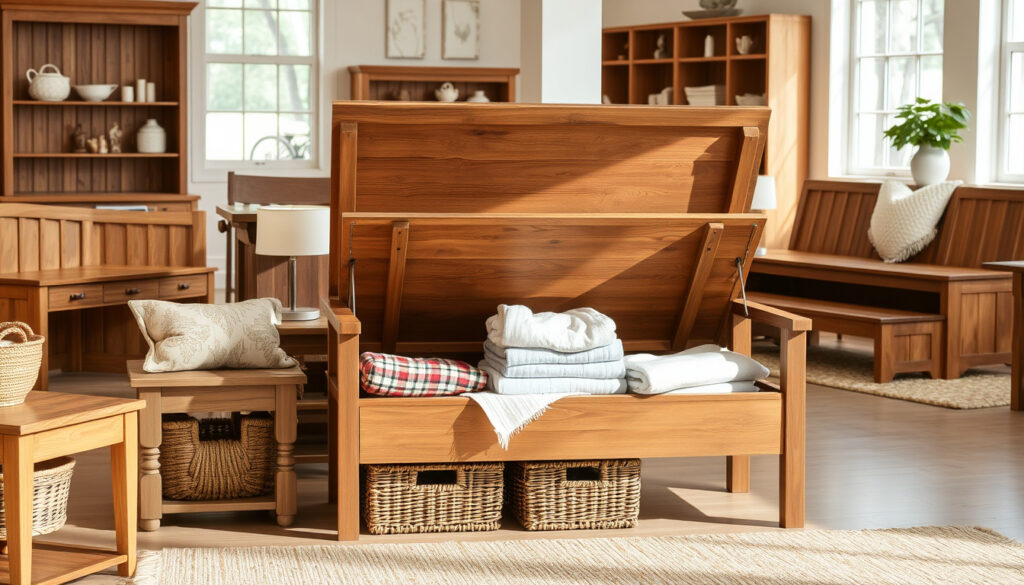
Anyone who has ever pulled on a pair of boots while balancing on one leg knows why the storage bench earned a permanent spot by the front door: it is a perch, a tidy-up point, and a hiding place for everything from board games to gardening gloves. This guide sorts out the main bench seat types, the dimensions that actually matter, and how to buy or build one that fits your space.
Typical bench seat height: 45–50 cm · Standard depth: 38–51 cm · Most common material: Wood · Average width of a storage bench: 90–180 cm · Number of bench seat types: 6+
Quick snapshot
- A storage bench combines seating with concealed or open storage beneath the seat (Bunnings Australia’s DIY guide).
- Cushions, blankets, sports equipment, toys, board games, gardening equipment, shoes and boots are the typical cargo (Bunnings Australia).
- IKEA tests its PERJOHAN bench with storage for a 110 kg load (IKEA Australia’s PERJOHAN page).
- Weight capacity changes with frame and span — IKEA’s 110 kg test figure applies to PERJOHAN, not to every storage bench on the market (IKEA Australia).
- Terms like “bench”, “settle” and “ottoman” overlap in furniture stores, so the same piece is often filed under different names. (IKEA Australia)
- Durability comparisons between lift-up, drawer and cubby storage mechanisms are thin; the options are documented by Australian Brief’s seating guide, but long-term testing is not.
- Seat depth is the spec people skip: VALTORP’s seat depth is 42 cm, while PERJOHAN is just 28 cm deep (IKEA Australia’s VALTORP page; IKEA Australia’s PERJOHAN page).
- Placement rules vary by model — PERJOHAN is recommended for indoor use and is not approved for bathrooms (IKEA Australia).
- Benches can be built to a custom length to match the exact available area (Bunnings Australia).
- Measure the space and the tallest item you plan to store, then choose between a lift-up lid, drawers, or cubbies (Australian Brief’s seating guide).
- Compare compact hallway models like KALLSÖ with two-seater benches like VALTORP once you know your depth limit (IKEA Australia’s KALLSÖ page; IKEA Australia).
- For a made-to-fit piece, follow Bunnings’ build guide and size the bench to your floor plan (Bunnings Australia).
The quick read: storage access and seat depth drive the buying decision more than length or material.
Six numbers, one pattern: seat height sits in a tight 45–50 cm band across most designs, while width and depth are where bench styles genuinely split (ranges per Australian Brief’s seating guide).
| Dimension | Typical value |
|---|---|
| Standard seat height | 45–50 cm |
| Standard seat depth | 38–51 cm |
| Most common material | Solid wood |
| Average width range | 90–180 cm |
| Number of main types | 6 |
| Typical weight capacity | 200–300 kg, depending on build; IKEA tests its 100 cm PERJOHAN to 110 kg (IKEA Australia) |
The ranges above are industry sizing conventions used by Australian retailers and DIY guides; exact numbers differ from product to product. For a specific model, trust the published spec sheet — IKEA Australia, for instance, lists full dimensions, seat depth, and load-tested capacity for each bench (VALTORP; PERJOHAN).
What is a seat bench?
In its simplest form, a seat bench is a long seat made for at least two people — sometimes with a backrest, often without. From that single silhouette, the category fans out into dining benches, hallway benches, outdoor park benches, and the storage benches that hide clutter underneath.
Storage is what turns a bench into a space-saving piece. A storage bench combines seating with concealed or open storage beneath the seat, according to Bunnings Australia’s DIY guide. The same guide lists the typical payload: cushions and blankets, sports equipment, toys, board games, gardening equipment, shoes and boots.
- Cushions and blankets for the living room
- Sports equipment and toys in a playroom or garage
- Board games near the dining table
- Gardening equipment on a porch or mudroom
- Shoes and boots by the entry door
What is a bench seat with storage called?
- Storage bench — the catch-all term used by most Australian retailers.
- Hall bench or entry bench — storage-focused benches for the front door.
- Bench with storage — the phrasing IKEA Australia uses for VALTORP and PERJOHAN.
- Ottoman bench — an upholstered bench with a hinged top in place of visible storage.
Retail naming is loose. IKEA Australia files a “storage bench” (KALLSÖ), a “bench with storage” (VALTORP and PERJOHAN), and a “storage bench with sliding doors” (MACKAPÄR) in the same category, so it pays to search all three phrasings (KALLSÖ; VALTORP; MACKAPÄR). Underneath, the storage access falls into three mechanisms, according to Australian Brief’s seating guide: a lift-up seat that opens the whole cavity, drawer storage for items you need often, and cubbies that keep things visible.
What do Australians call a bench?
In Australian English, “bench” means the same thing it means in the UK and North America: a long seat for several people. Australians also say “bench seat” for the same idea, especially when the seat is paired with a dining table.
- Bench — a long seat, indoor or outdoor.
- Bench seat — the seat itself, or a bench designed for a table.
- Park bench — public outdoor seating.
- Storage bench / hall bench — a bench with built-in storage for entryways.
There is no separate Australian slang word for a seating bench — the standard terms are the ones shoppers actually use. The one local twist is practical: in Australian retail, a bare “bench” search can also surface workbenches and kitchen benchtops, so “storage bench” is the phrase that consistently pulls up seating with hidden storage.
Why this matters: from Bunnings to IKEA, Australian retailers file these pieces under “bench”, so the right search term is the difference between a hallway seat and a kitchen benchtop in your results.
What are the different types of sitting benches?
Bench design splits along three simple lines: where the bench lives, whether it has a back, and what happens under the seat. Cross those axes and you get the six main types shoppers actually browse.
- Backless benches — classic dining and park benches that tuck neatly under tables.
- Benches with backrests — hallway and outdoor models built for comfort.
- Storage benches — lift-up, drawer, or cubby access beneath the seat.
- Outdoor benches — wooden, metal, rattan, or folding designs rated for weather.
- Indoor benches — hallway, entryway, and dining pieces, often upholstered.
- Ottoman and mobile benches — upholstered benches with hinged tops, sometimes on wheels.
What kinds of benches are there?
- By placement: indoor, outdoor, or indoor-outdoor.
- By backrest: with back, backless, or high-backed.
- By storage: storage top, open shelf, or solid top.
- By material: solid wood, metal, rattan or wicker, upholstered, plastic.
What are those benches called?
- Bench seat — the seat itself, or a bench made for a dining set.
- Storage bench — any bench with storage under the seat.
- Hall bench — a narrow bench, with or without storage, built for entryways.
- Settle — a traditional wooden bench with a high back and arms.
Under the seat, storage splits into three mechanisms, according to Australian Brief’s seating guide: a lift-up seat opens the full cavity, drawer storage offers front-facing access for organised items, and cubbies provide open or compartmentalised space below.
The trade-off: lift-up lids hide the biggest mess and hold bulky items, but drawers and cubbies are easier to use every day. Pick based on whether the bench is hiding clutter or organising it.
What are the standard sizes for benches?
Bench dimensions follow a surprisingly consistent rule: height stays in a narrow band while depth and width do the flexing. Standard seat height is 45–50 cm, depth runs 38–51 cm, and width spans 90 cm for a two-seater up to 180 cm for longer family benches, according to Australian Brief’s seating guide. Storage benches often run a little taller, around 50–60 cm, so a hinged top can clear the cavity below.
The published numbers on real products tell the story better than ranges. Three current IKEA Australia models show how much depth and width vary within one store:
- IKEA VALTORP — 103 cm wide, 46 cm deep, 47 cm high, with a 42 cm seat depth; IKEA describes it as seating two people with storage beneath a soft seat (IKEA Australia’s VALTORP page).
- IKEA PERJOHAN — 100 cm long, 28 cm deep, 45 cm high; seats two to three, is tested for a 110 kg load, and has internal storage of 87.9 cm × 20.3 cm × 13.1 cm (IKEA Australia’s PERJOHAN page).
- IKEA MACKAPÄR — 100 cm wide, 37 cm deep, 52 cm high; sliding doors, two adjustable shelves, and a 35 cm storage depth that fits shoes up to size 50 (IKEA Australia’s MACKAPÄR page).
The implication: width decides how many people fit, but depth decides whether the bench works in your hallway. A 28 cm-deep PERJOHAN slips into a tight entry; a 46 cm-deep VALTORP feels like proper seating.
A long bench can still be the wrong bench if the depth is off. PERJOHAN spans 100 cm yet sits only 28 cm deep — fine for quick shoe changes, cramped for lounging (IKEA Australia).
The pattern from the three IKEA models: width changes the seating count, but depth and storage cavity determine where the bench can live.
How to make a storage bench?
Building a storage bench is a weekend project with basic tools and a clear plan. The formula is the same whether you’re making a compact hallway bench or a long outdoor unit: box first, lid second, finish third.
- Plan the dimensions. Measure the space and decide on height, depth, and width. A custom build lets you size the bench to the exact area, as Bunnings Australia’s DIY guide explains.
- Choose the storage access. A hinged top gives full-cavity access; drawers suit items you grab often; cubbies keep things visible (Australian Brief’s seating guide).
- Source the timber and hardware. Cut the wood yourself or use a kit; you’ll need hinges, screws, and wood glue.
- Build the frame. Assemble the base box, then add front panels or openings for your chosen storage access.
- Fit the seat top. Attach the top with a piano hinge or lid stays so it opens safely and stays open.
- Sand and finish. Paint or stain protects the wood and suits indoor or outdoor placement.
The tool list is short: saw, drill, screws, sandpaper, wood glue, and hinges.
How to make bench seat Bunnings?
- Bunnings publishes a full DIY walkthrough for building a storage bench seat, including planning, materials, and assembly steps (Bunnings Australia’s build guide).
- The guide emphasises that storage benches can be built to a custom length based on the available area and intended use (Bunnings Australia).
- Shopping list: saw, drill, screws, sandpaper, wood glue, and hinge hardware.
The pattern: most DIY storage benches are a box with a hinged top, so the real skill is in the measurements, not the joinery. Get the height and depth right and assembly is straightforward.
The most common DIY mistake is building the storage cavity too shallow for what you actually own. IKEA’s PERJOHAN cavity is only 20.3 cm deep — enough for folded blankets and flat shoes, not toolboxes or sports balls (IKEA Australia). Design around the tallest item first.
The catch: get the measurements right and the build becomes a weekend job; get them wrong and you are left with a box that fits neither the room nor the items you wanted to store.
Where can I find a sitting bench with storage?
In Australia, storage benches are easy to find once you know the dimensions you need — the harder decision is matching a mechanism and material to your room. The two biggest sources are Bunnings for DIY and outdoor-ready pieces, and IKEA for compact, spec-heavy indoor benches.
Does Bunnings offer storage bench seats?
- Bunnings stocks outdoor and storage benches in several sizes and materials, including weather-ready options for patios and porches.
- For a made-to-measure result, Bunnings’ DIY guide shows how to build a storage bench to a custom length (Bunnings Australia’s build guide).
- Bunnings also sells the materials and hardware — timber, hinges, screws, stains — needed for a weekend build.
IKEA Australia’s current range gives concrete numbers to compare. The KALLSÖ storage bench is 80 cm wide, 38 cm deep, and 56 cm high, with drawers, and IKEA suggests it as a hallway seat (IKEA Australia’s KALLSÖ page). The MACKAPÄR storage bench adds sliding doors and a 35 cm storage depth that fits shoes up to size 50 (IKEA Australia’s MACKAPÄR page).
What are the best storage benches?
- Best for narrow hallways: IKEA PERJOHAN — 100 cm × 28 cm, tested for 110 kg, indoor use only (IKEA Australia’s PERJOHAN page).
- Best for two-person seating: IKEA VALTORP — 103 cm wide, 42 cm seat depth, storage under a soft seat (IKEA Australia’s VALTORP page).
- Best for shoe storage: IKEA MACKAPÄR — 35 cm storage depth, fits shoes up to size 50 (IKEA Australia’s MACKAPÄR page).
- Best for a styled look: Australian retailers such as Early Settler, Life Interiors, and Globewest carry upholstered and timber storage benches in their furniture ranges.
The catch: “best” depends on the doorway. A 120–180 cm bench suits a wide entry or mudroom; an 80 cm KALLSÖ is the practical pick for flats and narrow hallways.
Benches earn their keep when they double as organisation. The models that actually get used are the ones whose storage access matches a daily habit — drawers for shoes you grab every morning, lift-up lids for seasonal bulk.
What this means: the best pick is the one whose storage access and depth match the daily routine in that room, not the one with the longest seat.
What’s confirmed — and what’s still unclear
Shopping guides rarely separate verified specs from marketing filler. This is the split for bench seats, based on the sources behind this guide.
Confirmed facts
- Storage benches combine seating with concealed or open storage beneath the seat (Bunnings Australia).
- IKEA publishes full dimensions, seat depth, and load testing for its storage benches (VALTORP; PERJOHAN).
- Storage benches can be built to a custom length for a specific space (Bunnings Australia).
- PERJOHAN is indoor-only and not approved for bathrooms (IKEA Australia).
What’s unclear
- Generic weight capacities like 200–300 kg appear in marketing, but manufacturers rarely publish tested loads for every model; IKEA’s 110 kg figure applies to PERJOHAN specifically (IKEA Australia).
- Long-term durability data comparing lift-up, drawer, and cubby mechanisms is scarce; Australian Brief’s guide describes the options but does not test them (Australian Brief).
- Retail naming is not standardised — “storage bench”, “bench with storage”, and “hall bench” can describe the same product.
- Whether a bench can double as a coffee table depends on the model’s height, cushion depth, and how often you need a table surface.
The balance of evidence: verified specs are strong on dimensions and load testing, weak on mechanism durability — plan around the numbers, not the marketing.
What the sources say
The most useful bench-seat information comes from the two places that publish real numbers: the retailer that builds benches and the retailer that tests them.
Bunnings Australia’s DIY guide defines the storage bench as seating plus concealed or open storage beneath the seat, and lists cushions, blankets, sports equipment, toys, board games, gardening equipment, shoes and boots as the typical cargo.
Bunnings Australia — How to build a storage bench seat
IKEA Australia describes the VALTORP bench as seating two people with storage beneath a soft seat, and publishes a 42 cm seat depth alongside the bench’s 103 cm width and 46 cm depth.
IKEA Australia — VALTORP bench with storage
IKEA Australia’s PERJOHAN page specifies a 110 kg tested load, an internal storage cavity of 87.9 cm × 20.3 cm × 13.1 cm, and an indoor-only recommendation.
IKEA Australia — PERJOHAN bench with storage
The pattern: the sources with the most authority are the ones selling the product — because they publish test loads and exact dimensions — not the ones writing generic roundups.
Seat benches earn their keep because they solve a daily problem: there is never a good place to sit while pulling on shoes, and the clutter by the door has to live somewhere. Storage benches answer both at once, and in Australia the practical shortlist is short — Bunnings’ guides and hardware for a custom build, IKEA’s tested and dimensioned models for a quick buy, and local retailers such as Early Settler, Life Interiors, and Globewest for a glossier finish. For Australian shoppers, the decision is clear: measure the depth of your space first, choose the storage mechanism you will actually use, then buy or build to fit the width of the room — or end up with a bench that looks right but never gets sat on.
Frequently asked questions
Can a bench seat be used as a coffee table?
Yes, if the heights line up. A standard bench seat sits at 45–50 cm, which is close to coffee-table height, so a low backless bench can double as a table in a small living room. Keep cushions thin and choose a solid top if you plan to rest mugs on it (Australian Brief’s seating guide).
What is the best wood for a bench seat?
Solid wood is the most common bench material for good reason: it holds up to daily use, takes paint and stain well, and works indoors or out. For outdoor benches, look for hardwoods or treated timber that tolerate moisture; for indoor benches, almost any solid wood works if it is finished properly.
How to clean a fabric storage bench?
Vacuum the upholstery weekly, spot-clean spills immediately with mild detergent and water, and use a fabric protector on high-traffic benches. If the seat cushion has a removable cover, follow the manufacturer’s care label; if it does not, keep cleaning products gentle to avoid discolouring the fabric.
Are bench seats comfortable for long periods?
It depends on depth and cushioning. A 42 cm seat depth with a soft seat, like the VALTORP, is closer to chair comfort, while a 28 cm-deep hard-top bench like the PERJOHAN is built for quick perches rather than lounging (IKEA Australia; IKEA Australia).
Can you put a bench seat on a covered porch?
Yes, if the materials suit the exposure — but check the room-by-room guidance for each model. IKEA, for example, says PERJOHAN is recommended for indoor use and is not approved for bathrooms, so treat damp or semi-outdoor locations with caution (IKEA Australia).
How much weight can a typical storage bench hold?
It varies with frame, material, and span. IKEA tests its 100 cm PERJOHAN to a 110 kg load, and that published figure is the one to trust for a bench of that size — treat unverified marketing ranges as estimates (IKEA Australia).
What is the difference between a bench and a settle?
A bench is a long seat with or without a back. A settle is a traditional wooden bench with a high back and arms — closer to a built-in sofa. The modern storage bench is effectively the settle’s space-saving descendant, trading the tall back for a lid and storage cavity.
The through-line: whether you buy or build, the seat height stays roughly the same, so storage access and depth decide which bench earns its place by the door.
Related reading
- How to Read a Measuring Tape — the skill you need before measuring a hallway for a bench.
- Winter Boots Ireland Buying Guide — a parallel look at sizing, fit, and materials for bulky footwear that needs stowing.
The measuring-tape guide covers the first step in any bench project, and the winter-boots guide explains the bulky footwear that usually ends up stored underneath.
More related posts
 Who Is Rebecca Vallance? Founder, Husband & Production
 Jonathan LaPaglia: Survivor Exit, Doctor Career, Net Worth
 Isaac Newton: Laws of Motion, 2060 Prediction & Apple Myth
 Drew Starkey: Verified Facts and Relationship Rumors
 Rosa Salazar: Bio, Movies & Why Captain America Cut Her
 Paul Pogba: Monaco Return, Doping Ban, Salary & Net Worth 2025
 Mantra Mooloolaba Beach Guide: Rooms, Rates & Reviews
 Jessica Fox: Career, Health Scare TECHNICAL_RETRY
