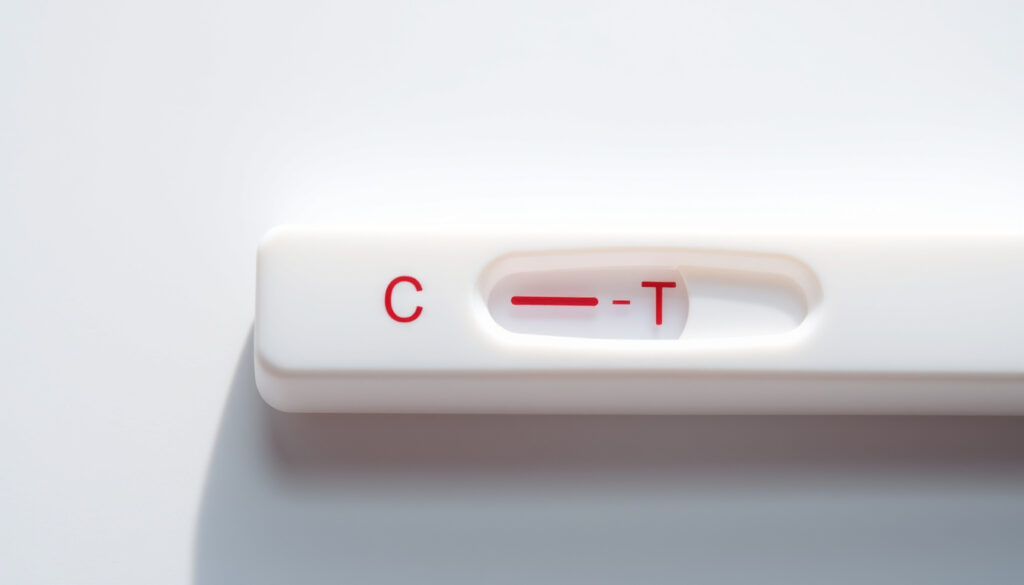
Positive COVID Test Picture: How to Read C and T Lines
When you’re staring at a small white plastic stick waiting for a line to appear, every second feels longer. COVID-19 rapid antigen tests have become a familiar part of life, but interpreting that faint pink band can be confusing. This guide walks you through exactly what a positive result looks like, how to read the C and T lines, and what a faint line really means — backed by official health authority instructions.
Test specificity: >99% ·
Test sensitivity (symptomatic): ~80% ·
Result read time: 15–30 minutes ·
Positive predictive value (high prevalence): >95%
Quick snapshot
- Two colored lines (C and T) mean positive — FDA (U.S. regulatory agency) instructions
- Any visible T line, even faint, counts as positive — Australian Government Health Department
- One line at C only = negative — UK DHSC (government health authority)
- Exact sensitivity varies by brand and viral load — no single number applies to all tests (Cedars-Sinai (academic medical center) notes)
- Whether a faint line means lower contagiousness is not precisely quantified — Cedars-Sinai (academic medical center) notes
- Read result exactly at 15–30 minutes — reading earlier or later may give wrong result — FDA instructions
- Invalid test (no C line) requires a new test with a fresh kit — UK DHSC guidance
- A positive result means isolate and follow local health guidelines — CDC (U.S. public health authority)
- Consider confirming with a PCR test if you need official documentation — FDA consumer guidance
Six key facts, one pattern: lateral-flow antigen tests rely on the same C-and-T interpretation framework worldwide, but performance metrics vary significantly between brands and user technique.
| Fact | Value |
|---|---|
| Test type | Lateral flow rapid antigen test |
| Approved by | FDA EUA and WHO EUL |
| Sensitivity (symptomatic) | ~80% |
| Specificity | >99% |
| Result time | 15–30 minutes |
| Positive result | Two lines (C and T) |
What does a positive COVID test look like?
Visual appearance of positive result
A positive COVID-19 rapid antigen test shows two colored lines — one at the control region (C) and one at the test region (T). The lines are typically pink, red, or purple, depending on the brand’s reagent. According to FDA (U.S. regulatory agency) instructions, both lines must be present for a positive reading, regardless of how dark or light the T line appears. You do not need a thick or bright T line; any visible line counts.
“You may see a very light line next to T. This means you are positive.”
— Australian Government Health Department
The Australian Government Health Department’s easy-read guide reinforces this: “You may see a very light line next to T. This means you are positive.” The same principle is stated in UK DHSC (government health authority) guidance, which describes the result as “one line by C and one line by T. The lines can be bright or faint.”
Common differences between test brands
Not all rapid antigen tests look identical. The cassette design, line color, and development time vary between manufacturers such as iHealth, Abbott BinaxNOW, and Flowflex. Despite these cosmetic differences, the binary interpretation stays the same: two lines equals positive. Cedars-Sinai (Los Angeles–based academic medical center) emphasizes that test line brightness should never change the basic interpretation — “two lines means positive, one line means negative.”
A patient judging by line intensity risks dismissing a faint positive as negative, potentially spreading infection. The rule is binary: any T line is a positive, no matter how pale.
The implication: regardless of the brand you use, focus on the presence of two lines, not their darkness. Your eyes may play tricks — wait the full development time before checking.
Is the C or T positive?
Role of the control line (C)
The C line is the control. It verifies that the test worked correctly — that the fluid migrated across the membrane and the reagents functioned. FDA manufacturer instructions state that the control line must appear for the result to be valid. If there is no C line, the test is invalid, regardless of what the T line shows. According to PPE Supply (rapid test distributor blog), “the control line indicates that the test ran properly and serves as an internal quality check.”
Role of the test line (T)
The T line is the test line. It contains antibodies that bind to SARS-CoV-2 antigens if present in your sample. Any visible signal at T means the test detected the virus. FDA guidance is clear: “If both the C and T lines are visible, the result is positive.”
What a missing C line means
If the C line does not appear, the test is void. UK DHSC guidance describes void results as occurring “when there are no lines or only a T line.” In such cases, you must discard the test and repeat with a new kit. Do not interpret a missing C line as negative.
“A void result occurs when there are no lines or only a T line.”
— UK DHSC (government health authority)
A missing C line with a faint T line could trick someone into thinking they are positive when in reality the test never worked. Always check for the control line first.
The pattern: C validates the test, T reveals the infection. If C is absent, the result is inconclusive — repeat the test.
How to tell if it’s positive or negative?
Reading one line vs two lines
The rule is simple: one line at C only means negative; two lines (C plus T) means positive. FDA instructions specify: “If only the C line is visible and the T line is not visible, the result is negative.” UK DHSC confirms the same: “A negative result is one line by C and no line by T.”
Distinguishing a faint positive from a negative
A faint T line often causes confusion. People may assume the test is negative because the line is barely visible. But according to Australian Government Health Department, “a very light line next to T means you are positive.” The Cedars-Sinai Newsroom adds that a faint line, though still positive, “may indicate less virus, a person nearing the end of infection, or a poorer swab sample.”
The trade-off: you cannot distinguish active infection from tail-end viral shedding based on line brightness alone. Treat any T line as infectious and isolate accordingly.
What does a faint line on a COVID test mean?
Causes of a faint T line
A faint T line can occur for several reasons. Cedars-Sinai notes that a fainter line “could indicate less virus, the person is near the end of infection, or the swab sample was not ideal.” Early in infection, viral load may be low, producing a thin line. Late in infection, the same can happen as the body clears the virus.
False positive risk
Rapid antigen tests have very high specificity (>99%), meaning false positives are rare. According to FDA data, the iHealth test correctly identified 98.1% of negative samples in a lay-user study. Most faint lines are true positives, not errors. However, if the test is read after 30 minutes, evaporation lines can appear, leading to misreading. Always read at the manufacturer’s recommended time window.
When to retest with a faint line
If you see a faint T line, the test is positive. Australian Government guidance recommends treating it as confirmed. You can retest with a new kit to confirm, but the first result already warrants isolation. CDC (U.S. public health authority) advises that a positive antigen test does not require confirmatory PCR in most cases.
A faint line is not a false positive. It is a real signal that the test found viral antigens. The question is not whether you are infected, but how much virus you may be shedding — and that is not something a line intensity can tell you.
What this means: for practical purposes, a faint line is still a red light. Act as if you have COVID-19 — isolate, inform close contacts, and monitor symptoms.
How to do a rapid antigen test from your nose
Step-by-step self-testing instructions
Proper technique reduces the risk of an invalid or misleading result. Follow these steps aligned with FDA (U.S. regulatory agency) manufacturer instructions and UK DHSC (government health authority) easy-read guide:
- Wash or sanitize your hands before opening the test kit.
- Blow your nose gently to clear excess mucus.
- Remove the swab from the packaging — avoid touching the soft tip.
- Insert the swab 2–2.5 cm into one nostril (about the depth of the soft tip). Rotate the swab 5 times against the inner wall for 15 seconds.
- Using the same swab, repeat in the other nostril. This ensures you collect a good sample from both sides.
- Insert the swab into the reagent tube, mix by stirring or rotating as instructed, and leave it in for the specified time (usually 1 minute).
- Remove the swab while squeezing the tube to extract liquid, then cap the nozzle.
- Place 3–5 drops of the mixture into the test cassette’s sample well.
- Set a timer for 15 minutes. Do not disturb the cassette during development.
- Read the result between 15 and 30 minutes. After 30 minutes, the test may develop false lines and should be discarded.
Common mistakes to avoid
- Inserting the swab too shallowly — the tip must reach the nasal turbinates for a good sample.
- Using too many or too few drops can cause invalid or faint results.
- Reading the test too early (before 15 minutes) may miss a developing T line.
- Reading after 30 minutes risks evaporation lines that mimic a positive.
After the test: disposal and reporting
Place all used test components in a sealed plastic bag and dispose of them in household waste. Wash your hands afterwards. A positive result should be reported to local health authorities as required in your region. CDC (U.S. public health authority) provides guidance on self-reporting. If you work in healthcare or travel, confirmatory PCR may be needed for documentation.
The pattern: careful technique and correct timing minimize false negatives and invalid results.
For any questions about your specific test brand, consult the package insert. Two related health guides you might find useful: Blair Athol Medical Clinic services and Ritalin side effects overview.
For those wondering how to interpret their results, understanding what a positive COVID test in Ireland means can help clarify next steps.
Frequently asked questions
How long does it take to get a result from a rapid antigen test?
Most tests require 15–30 minutes of development time. Do not read results before 15 minutes or after 30 minutes.
Can I reuse a COVID test if the result is invalid?
No. An invalid test (no C line) must be discarded, and a new test kit should be used.
What should I do if my test result is positive?
Isolate immediately, inform close contacts, and follow local health department guidance.
Do I need to confirm a positive home test with a PCR test?
In most cases, no. Antigen tests are highly specific and reliable for positive results, though PCR may be needed for travel or work.
Are rapid antigen tests as accurate as PCR tests?
No. Antigen tests have lower sensitivity (~80% for symptomatic individuals) compared to PCR, but they offer speed and convenience.
Can a negative test result be wrong?
Yes. False negatives occur, especially early in infection. If symptoms persist, test again after 24–48 hours.
How should I dispose of a used test kit?
Place all components in a sealed plastic bag and dispose in household waste. Wash hands after handling.
Is it normal for the T line to develop slowly?
Yes. Some tests show the T line faintly at first and darken over 15–30 minutes. Wait the full development time before interpreting.
For the person staring at that little plastic stick, the decision comes down to one thing: if you see two lines — no matter how faint — treat it as positive. The line is not a suggestion; it’s a signal to act. Isolate, inform others, and look after yourself.
More related posts
 Tina Fey: Biography, Career, Family, and Net Worth
 Marco Polo: Biography, Travels, and Lasting Legacy
 Taylor Sheridan: Net Worth, Costner Feud, All Shows
 Martin Kemp: Health, Wealth, and Why He Has No Friends
 Reese Witherspoon: Family, Relationships & Career Insights
 Jacob Tremblay: Age, Career, and What He’s Doing in 2026
 Amazon Prime Subscription: Cost, Plans & Discounts in Ireland
 Bankwest Broker Portal: Login, Features & Support for Brokers
