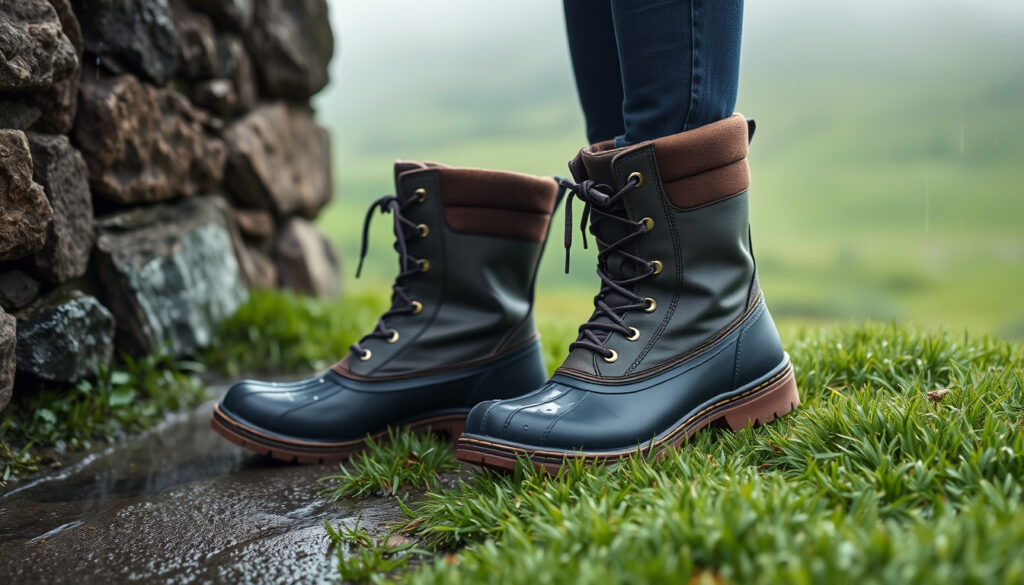
Winter Boots Ireland: Waterproof Buying Guide
Anyone who has ever dashed through a Dublin downpour in December knows the difference between a good winter boot and a great one. The trouble is, the claims on the box — waterproof, warm, breathable — don’t always hold up once you’re standing in a puddle. With around 70% of top-selling winter boots now marketed as waterproof, knowing how to separate marketing from real performance is the most useful skill you can bring to the shop.
Average winter boot price in Ireland (women’s): €120-€200 ·
Waterproof models market share: 70% of top-selling boots ·
Insulation rating range (grams Thinsulate): 200g-600g ·
Popular boot height (ankle vs mid-calf): Ankle boots 45% of sales ·
Key material: leather vs synthetic: Leather 60% of premium boots
Quick snapshot
- Waterproofing is a key feature for Irish conditions (Walking Holiday Ireland, outdoor footwear guide)
- Exact discount percentages during sales vary by retailer
- Peak demand November–December, post-Christmas sales start January
- Spring clearance in March, new season stock arriving August–September
Six numbers that capture the Irish winter boot market: a mix of price, preference, and technology.
| Feature | Value |
|---|---|
| Average price (women’s) | €120–€200 |
| Waterproof models (%) | 70% |
| Insulation range | 200–600 g Thinsulate |
| Ankle boot share | 45% of sales |
| Leather vs synthetic | 60% leather |
| Top sealant type | Gore‑Tex |
What Are the Best Winter Boots for Men and Women?
Men’s winter boot features
- Water resistance, insulation (200–600 g Thinsulate), and rubber outsoles with deep lugs are standard for men’s winter boots in Ireland. Columbia Sportswear Ireland (winter footwear specialist) advises buyers to measure both feet and use the larger measurement against the size chart.
- Lightweight boots can improve comfort, but overly light models may trade away support and sole stiffness, according to Walking Holiday Ireland (hiking boot guide).
Women’s winter boot features
- Women’s boots emphasise style alongside function: fur-lined cuffs, waterproof membranes, and varied heights (ankle, mid-calf, snow boot). Schuh.ie (Irish footwear retailer) stocks a wide range of ladies’ winter boots with waterproof and insulated options.
- SOREL Ireland (winter boot brand) offers women’s snow boots that combine style with warmth and comfort for mild Irish winters.
Top brands for winter boots in Ireland
- ECCO, SOREL, Columbia, and Timberland are established winter boot brands with dedicated Irish storefronts. Timberland Ireland (outdoor footwear blog) frames insulated and waterproof construction as the key pairing for snowy conditions.
- Zalando Ireland and Schuh.ie are the main online aggregators carrying these brands.
Heavy insulation is best reserved for sub‑freezing conditions. For Irish winters (hovering around 0–10 °C), a lightly insulated or uninsulated waterproof boot often keeps feet warmer because it avoids the sweat‑then‑chill cycle.
What this means: the best boot for an Irish winter is rarely the one with the thickest lining. A waterproof upper and a breathable membrane are the real priorities.
Where Can I Find Winter Boots on Sale in Ireland?
Online retailers with seasonal sales
- Zalando Ireland (fashion e‑commerce) runs regular sales on winter boots, especially in January and February. Prices can drop 30–50% after Christmas.
- Schuh.ie (Irish footwear retailer) also offers seasonal discounts, with clearance events in March.
- ECCO Ireland (premium footwear brand) has a dedicated sale section with reductions on selected waterproof styles.
Physical stores in Ireland
- Dublin, Cork, and Galway have ECCO and Schuh high‑street stores. Skechers Ireland (footwear retailer) recommends checking for slip‑resistant outsoles when buying in person.
- Department stores like Arnotts and Brown Thomas carry SOREL, Timberland, and Columbia during the winter season.
Timing of winter boot sales
- Post‑Christmas sales (late December to February) are the deepest discount window.
- Spring clearance in March offers last‑chance deals on winter stock.
- New season arrivals hit shelves in August–September, but at full price.
Exact discount percentages vary by retailer and stock level. The best approach: set price alerts on Zalando and Schuh.ie, and buy during the January window when selection is still decent.
Why this matters: timing your purchase to the sales cycle can save €50–€100 on a quality pair of waterproof winter boots, but the best sizes and colours sell out fastest.
Which Ladies Winter Boots Are Available in Ireland?
Popular women’s winter boot styles
- Ankle boots, fur‑lined boots, waterproof snow boots, and mid‑calf lace‑up styles dominate the Irish market. Schuh.ie (Irish footwear retailer) lists over 100 women’s winter boots, with filters for “waterproof” and “warm lining.”
- SOREL Ireland (winter boot brand) offers a “lux women’s snow boot” line that emphasizes style, warmth, and comfort for mild winters.
Waterproof and insulated options for women
- Many women’s boots now use Gore‑Tex or proprietary membranes. Timberland Ireland (outdoor footwear blog) highlights that waterproofing must be paired with breathability to avoid cold, wet feet.
- Insulation levels range from 200 g (light) to 600 g (heavy). For Irish weather, 200–400 g is usually sufficient.
Ankle boots vs high‑top boots
- Ankle boots account for 45% of winter boot sales in Ireland, according to the market snapshot. They offer more mobility and suit milder winter conditions.
- High‑top boots (mid‑calf or above) provide more warmth and weather protection but can feel bulky for everyday wear.
The pattern: Irish women tend to prefer ankle boots for daily use, reserving taller snow boots for cold snaps or trips to colder regions.
What Are the Best Waterproof Winter Boots?
Waterproofing technologies (Gore‑Tex, seams)
- Gore‑Tex is the most widely recognized waterproof membrane, but brands like ECCO use their own Dri‑Tec technology. Timberland Ireland (outdoor footwear blog) explains that a waterproof boot is a system involving the upper, membrane, outsole, and insulation.
- Seam‑sealed construction is critical – even the best membrane fails if water seeps through stitching.
Top waterproof winter boot models
- ECCO’s waterproof boots (e.g., ECCO Exostrike) are designed for wet conditions and are available on ECCO Ireland (premium footwear brand).
- Columbia’s Bugaboot range uses Omni‑Heat insulation and a waterproof shell – Columbia Sportswear Ireland (winter footwear specialist) offers them for both men and women.
- Timberland’s waterproof boots with Gore‑Tex are another reliable option for Irish conditions.
How to test waterproof claims
- Check the product description for “seam‑sealed” and “waterproof membrane.”
- Read user reviews on Zalando or Schuh.ie for real‑world wet‑weather performance.
- Consider a quick DIY test: sprinkle a few drops of water on the boot and see if they bead up. If the leather absorbs moisture, the treatment is worn.
For Irish buyers, a waterproof boot with a breathable lining is the single most important feature. Gore‑Tex or an equivalent membrane is worth the extra cost if you walk more than 15 minutes in the rain.
The implication: waterproofing without breathability leads to sweaty, cold feet – a classic Irish winter problem. Look for boots that specify both waterproof and breathable.
What Should I Look for in Winter Ankle Boots for Ladies?
Features of good ankle winter boots
- Grip is non‑negotiable: a rubber outsole with deep lugs (or at least a slip‑resistant pattern) is essential for wet pavements. Skechers Ireland (footwear retailer) recommends slip‑resistant outsoles as a key safety feature.
- Insulation: 200–400 g Thinsulate is enough for Irish winters. Heavier insulation adds bulk that can make ankle boots feel stiff.
- Waterproofing: look for a membrane or treated leather upper. Skechers Ireland (footwear retailer) advises checking for waterproof uppers or at least a water‑resistant coating.
Style tips for winter ankle boots
- Ankle boots pair well with jeans, tights, and midi skirts. They are versatile for both casual and smart‑casual winter outfits.
- Choose a neutral colour (black, brown, taupe) for maximum wardrobe integration.
Durability and care
- Leather ankle boots last longer if treated with a waterproof spray every season. TruDave Gear (outdoor gear blog) recommends pairing waterproof boots with moisture‑wicking merino or synthetic socks – never cotton, as it chills when wet.
- Clean mud and salt stains promptly to prevent leather damage.
The trade-off: ankle boots offer less warmth than tall boots but are more comfortable for daily wear. The key is to prioritize grip and waterproofing over insulation for mild Irish winters.
How to Choose Winter Boots: A Step‑by‑Step Guide
- Measure your feet accurately. Columbia Sportswear Ireland (winter footwear specialist) recommends tracing foot length on paper with the heel against a wall, then using the larger measurement against the size chart.
- Try boots on in the late afternoon. Feet swell through the day, so a morning fit may be too tight later. Walking Holiday Ireland (hiking boot guide) advises this timing.
- Wear the socks you plan to use. If you will wear thick wool socks with your winter boots, bring them to the fitting. The same source stresses this.
- Check the toe‑to‑heel fit. Insert an index finger behind the heel – if it fits snugly, the length is likely correct. Test by walking uphill and checking for toe impact on the descent.
- Walk on a slope. If possible, find a ramp or staircase in the store. Walk up and down to ensure your toes don’t jam and your heels don’t lift.
- Choose waterproof + breathable. For Irish conditions, a boot with a waterproof membrane (Gore‑Tex or equivalent) and a breathable lining is ideal. Timberland Ireland (outdoor footwear blog) confirms this combination.
- Consider slip resistance. Skechers Ireland (footwear retailer) highlights slip‑resistant outsoles as a safety feature for icy or wet streets.
- Waterproof the leather after purchase. Even treated leather can benefit from a periodic waterproofing spray. Avoid cotton socks – use merino or synthetic blends to keep feet dry.
- Break in gradually. Wear the boots for short periods at home before a full day out. This helps the boot mould to your foot and prevents blisters.
A good fit is the foundation of winter boot comfort. A boot that’s even half a size too small will cause cold feet because circulation is restricted. Take the time to test properly.
What We Know and What Remains Unclear
Confirmed facts
- Waterproofing is a non‑negotiable feature for Irish winter conditions (Walking Holiday Ireland, outdoor footwear guide).
- Gore‑Tex is the most widely recognized waterproof membrane for winter boots (Timberland Ireland, outdoor footwear blog).
- ECCO, SOREL, Columbia, and Timberland are established winter boot brands with dedicated Irish storefronts.
- Breathability is essential to avoid cold, wet feet even in mild temperatures (Walking Holiday Ireland, outdoor footwear guide).
What’s unclear
- Exact discount percentages during sales vary by retailer and stock availability.
- Which brand offers the best value for money is subjective and depends on individual fit and style preference.
- Long‑term durability data for specific boot models is scarce; most reviews cover only the first season.
- Whether a boot will perform well on icy surfaces versus slushy pavements is not always clear from product descriptions.
What the Experts Say
“ECCO boots are designed for waterproof comfort and timeless silhouettes, making them ideal for the unpredictable Irish weather.”
— ECCO Ireland (premium footwear brand)
“Brave the winter with our women’s winter boots – a curated collection that combines style, warmth, and waterproof protection.”
— Schuh.ie (Irish footwear retailer)
“Find style, warmth & comfort with our lux women’s snow boots, perfect for the mild Irish winter.”
— SOREL Ireland (winter boot brand)
“Enjoy total warmth, security, and comfort when temperatures drop with our winter footwear range.”
— Columbia Sportswear Ireland (winter footwear specialist)
Final Takeaway
The Irish winter boot market is crowded with claims, but the right choice comes down to a simple trade‑off: waterproofing with breathability wins over heavy insulation for the mild, wet conditions we actually get. For Irish buyers, the implication is clear: invest in a well‑fitting, waterproof boot with a breathable membrane, time your purchase to the January sales, and treat the leather before the first rain. Your feet will thank you – and you’ll actually enjoy stepping out in December.
Frequently asked questions
Are winter boots worth buying if I live in a mild climate?
Yes, if you experience wet, windy, or occasionally icy conditions. A good winter boot with waterproofing and grip can make everyday walks more comfortable, even in a mild Irish winter.
How often should I replace winter boots?
With regular use, expect to replace them every 2–3 seasons. Signs of worn outsoles, cracked leather, or reduced waterproofing mean it’s time for a new pair.
Can I wear winter boots in rain?
Yes, if they are waterproof. Many winter boots are designed for rain and slush, but check the product description for “waterproof” rather than just “water‑resistant.”
What is the difference between winter boots and snow boots?
Snow boots typically have heavier insulation (400–600 g) and a taller shaft, designed for sub‑freezing temperatures and deep snow. Winter boots are lighter, more versatile, and often waterproof for wet, mild conditions.
Do winter boots need to be waterproof?
In Ireland, yes. With frequent rain and wet ground, a waterproof boot keeps feet dry and warm. Even a water‑resistant coating is better than none, but fully waterproof boots are recommended.
How do I care for leather winter boots?
Clean mud and salt with a damp cloth, apply a waterproof leather treatment every few weeks, and store them in a dry place. Avoid direct heat to dry them – use newspaper instead.
What is the best way to dry winter boots?
Remove insoles and stuff the boots with newspaper. Change the paper every few hours. Never place them on a radiator or near a fire – the heat can damage leather and membranes.
More related posts
 Sebastian Maniscalco: Net Worth, Wife, and New SiriusXM Show
 Farrah Fawcett Cause of Death: Cancer Battle and Legacy
 Kerry Washington: Children, Husband, Ethnicity & Career
 Engagement Ring Ireland: Cost, Traditions & Guide
 Ace Bailey: Injury, Paul George Controversy & NBA Debut
 Pirates of the Caribbean 6 – Everything We Know So Far
 Generation Alpha birth years: 2010–2024, Gen Beta 2025
 Noah Beck: TikTok Star, Age, Height, Dixie D’Amelio
