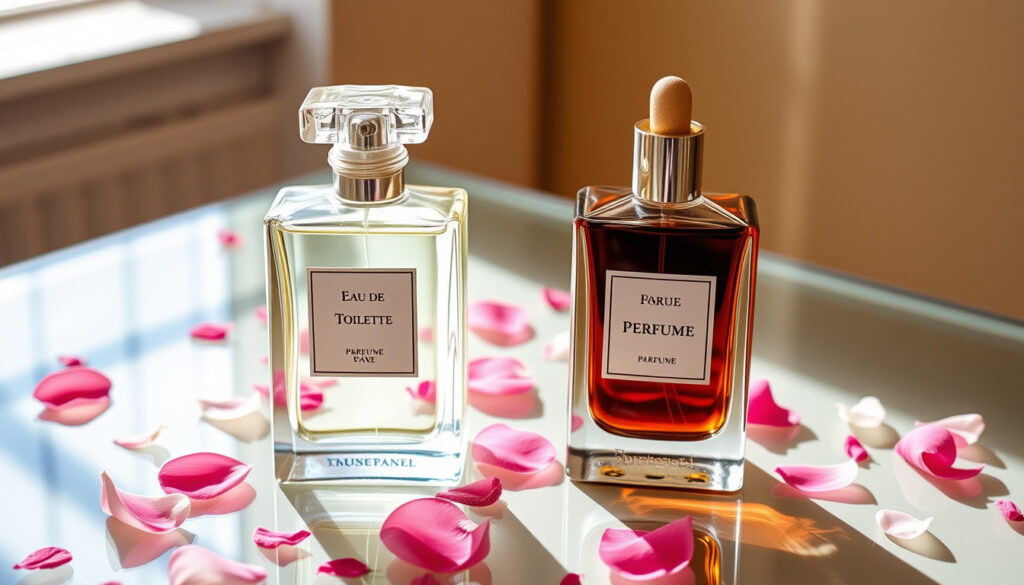
Eau De Toilette vs Perfume: Meaning & Differences
You’ve stood in front of a fragrance counter, squinting at the tiny letters on the bottle: Eau de Toilette, Eau de Parfum, Parfum — what do they actually mean, and why does one last all day while the other fades by lunch? Eau de Toilette, French for “grooming water,” typically contains 5%–15% fragrance oil (Ulta Beauty, a leading US beauty retailer), making it the lightest common concentration.
Fragrance oil concentration range (EDT): 5%–15% ·
Typical longevity on skin (EDT): 2–4 hours ·
Alcohol content (EDT): 80%–90% ·
Fragrance oil concentration range (EDP): 15%–20% ·
Typical longevity on skin (EDP): 4–8 hours ·
Fragrance oil concentration range (Parfum): 20%–30%
Quick snapshot
- EDT contains 5%–15% fragrance oil (Ulta Beauty)
- EDT lasts 2–4 hours on skin (The Perfume Shop, UK fragrance specialist)
- EDP lasts 4–8 hours (Ulta Beauty)
- Parfum lasts 6–8+ hours (Commodity Fragrances, US fragrance brand)
- Exact longevity varies by individual skin chemistry and environment
- Whether EDT or EDP is “better” is subjective and depends on personal preference
- No fixed industry timeline; concentration ranges vary by brand (Odorem, French fragrance education site)
- Check the label: look for EDT, EDP, or Parfum to match your needs
Eight key specs across three concentrations, one pattern: the higher the oil percentage, the longer the scent stays with you.
| Attribute | Eau de Toilette (EDT) | Eau de Parfum (EDP) | Parfum (Extrait) |
|---|---|---|---|
| Common concentration (EDT) | 5%–15% | 15%–20% | 20%–30% |
| Longevity on skin (EDT) | 2–4 hours | 4–8 hours | 6–8+ hours |
| Alcohol content (EDT) | 80%–90% | 70%–85% | 60%–80% |
| Typical price range (50ml) | $30–$80 | $60–$150 | $100–$300+ |
| Sillage (projection) | Light to moderate | Moderate to strong | Strong |
| Best use case | Daytime, office, warm weather | All-day, events, evening | Special occasions, cool weather |
What does eau de toilette mean?
Origin of the term eau de toilette
The phrase eau de toilette comes from French, where “eau” means water and “toilette” refers to the act of grooming or washing. Historically, it was a light, refreshing liquid used after shaving or bathing (Wikipedia).
Translation from French to English
Literally, “grooming water.” The Merriam-Webster dictionary defines it as a perfumed liquid with a lower concentration of fragrance oils than perfume.
EDT typically contains 5%–15% fragrance oil (Ulta Beauty). The high alcohol content — 80%–90% — makes it evaporate quickly, leaving a lighter scent.
Eau de Toilette is not a weaker version of perfume; it’s a different tool — designed for freshness, not endurance.
The implication: EDT’s formula prioritizes a quick, refreshing burst over lasting power.
What is the difference between perfume and eau de toilette?
Fragrance oil concentration differences
Perfume (Parfum) packs 20%–30% fragrance oil, while EDT sits at 5%–15% (Commodity Fragrances). Eau de Parfum falls in between at 15%–20% (Scentstore, UK perfume retailer).
Longevity: how long EDT lasts vs Perfume
EDT lasts about 2–4 hours on skin (The Perfume Shop). EDP lasts 4–8 hours (Ulta Beauty). Parfum can last 6–8+ hours (Commodity Fragrances).
Price differences between EDT and perfume
Because EDT uses less fragrance oil, it costs less — typically $30–$80 for 50ml, compared to $60–$150 for EDP and $100+ for Parfum.
What this means: If you’re after a scent that lasts through a workday, EDT will need reapplication. Perfume is a one-and-done play.
Which is better, EDP or EDT?
When to choose EDP
EDP is stronger, lasts longer, and projects more. Choose it for evening events, cooler weather, or when you want a signature scent that stays put.
When to choose EDT
EDT is lighter and more subtle. Ideal for the office, daytime, gym, or hot summer days when a heavy perfume would be cloying.
EDT vs EDP for daily wear
For daily use, many people prefer EDT because it’s less intrusive. You can reapply without overwhelming yourself or others. EDP suits those who want a single application to last.
The trade-off: EDT offers freshness and flexibility at the cost of longevity. EDP gives you sticking power but can feel heavy in heat.
A 50ml bottle of EDT used three times a day will last roughly 2 months; a 50ml EDP used once a day may last 3–4 months. The cost per wear can flip depending on your habits.
The pattern: your choice depends on how often you reapply, not just the upfront price.
Why does eau de toilette not last long?
Role of low fragrance oil concentration
With only 5%–15% perfume essence (Twisted Lily, US niche perfume retailer), there’s less oil to cling to your skin. The alcohol — 80%–90% — evaporates rapidly, carrying the scent away.
Effect of high alcohol content
Alcohol is a volatile carrier. The higher the alcohol percentage, the faster the scent disperses. EDT’s formula is designed for a quick burst of freshness, not a marathon.
Skin chemistry and application method
Moisturized skin holds fragrance longer. Applying EDT to pulse points (wrists, neck) after lotion can extend wear time by an hour or more.
The catch: Even with perfect application, EDT’s base composition limits longevity. It’s not a failure of the product — it’s the product’s design.
Should I wear perfume or eau de toilette?
Occasion-based selection
EDT suits casual, daytime, and office settings. Perfume (Parfum) is better for evening events, formal occasions, or dates when you want a lasting impression.
Weather and season
In warm weather, EDT feels lighter and more comfortable. In cold weather, the warmth of the skin amplifies perfume, making it a better match.
Personal scent preference
If you like subtle, evolving scents, EDT is your friend. If you prefer a single, confident statement, go with EDP or Parfum.
Why this matters: Spraying a heavy Parfum on a hot commute can be overwhelming — for you and everyone in the elevator. EDT gives you a social grace.
Eau de Toilette: Upsides and Downsides
Upsides
- Lighter, fresher scent — perfect for daytime
- Less expensive than EDP or Parfum
- High alcohol content gives a clean, quick-dry feel
- Easy to layer or reapply without overdoing it
Downsides
- Short longevity — 2–4 hours on skin
- Requires reapplication for all-day wear
- May not suit formal or evening occasions
- Sillage is light; won’t project across a room
Confirmed facts vs. What’s still unclear
Confirmed facts
- Eau de toilette means “grooming water” in French (Merriam-Webster)
- EDT contains 5%–15% fragrance oil (Ulta Beauty)
- EDT lasts 2–4 hours (The Perfume Shop)
- EDP lasts 4–8 hours (Ulta Beauty)
- Parfum lasts 6–8+ hours (Commodity Fragrances)
What’s unclear
- Exact longevity varies by individual skin chemistry and environment
- Whether EDT or EDP is “better” is subjective and depends on personal preference
Expert perspectives on Eau de Toilette
“Eau de toilette is a perfumed liquid that is less concentrated than perfume and is used as a light, fresh scent.”
“Eau de toilette is a lightly scented fragrance with a lower concentration of perfume oils, typically 5% to 15%, and is designed to be used as a refreshing splash.”
“EDT is perfect for daytime wear because it’s lighter and less overpowering than EDP. You can reapply throughout the day without it becoming too heavy.”
For the everyday fragrance buyer, the choice is clear: if you want a light, casual scent for daytime, EDT is your pick; if you need longevity for a long evening, go for EDP or Parfum.
carnerbarcelona.com, luvoparfums.com, nocibe.fr, scento.com, lateliero.com, smellstories.be
Frequently asked questions
What is the meaning of eau de toilette in French?
“Eau de toilette” translates to “grooming water” in French. It refers to a light, refreshing scented liquid traditionally used after washing or shaving (Wikipedia).
Does eau de toilette last longer than body spray?
Yes, EDT has a higher fragrance oil concentration (5%–15%) than most body sprays (typically 1%–3%), so it lasts longer — about 2–4 hours versus 1–2 hours for body spray.
Can you layer eau de toilette with perfume?
Yes, layering is common. Apply the stronger perfume first, then a lighter EDT over it, or use an unscented lotion as a base. This can create a custom scent and improve longevity.
Is eau de toilette good for everyday wear?
Absolutely. Its light, fresh character makes it ideal for daily use — especially at the office, in warm weather, or for casual outings. Just plan to reapply if you need it to last.
How should I store eau de toilette?
Store EDT in a cool, dark place away from direct sunlight and heat. The alcohol content makes it volatile, so avoid bathroom cabinets where temperature and humidity fluctuate.
What is the difference between cologne and eau de toilette?
Cologne (Eau de Cologne) typically has 2%–5% fragrance oil, making it even lighter than EDT. EDT has 5%–15%, so it falls between cologne and Eau de Parfum in strength and longevity.
More related posts
 Wedge Tailed Eagle Size vs Bald Eagle: Facts & Myths
 Shane Lowry: Age, Wife, Net Worth, Religion & Career
 Olivia Holt: Age, Dating, Black Belt & Career
 Kate Walsh: Brain Tumor, Net Worth, and Personal Life
 Alex Caruso: Hair Loss, Ethnicity, Lakers Trade & More
 Mary and George – The True Story Behind the Series
 Katie Allen: Australian Politician and Medical Researcher
 Kerry Washington: Children, Husband, Ethnicity & Career
