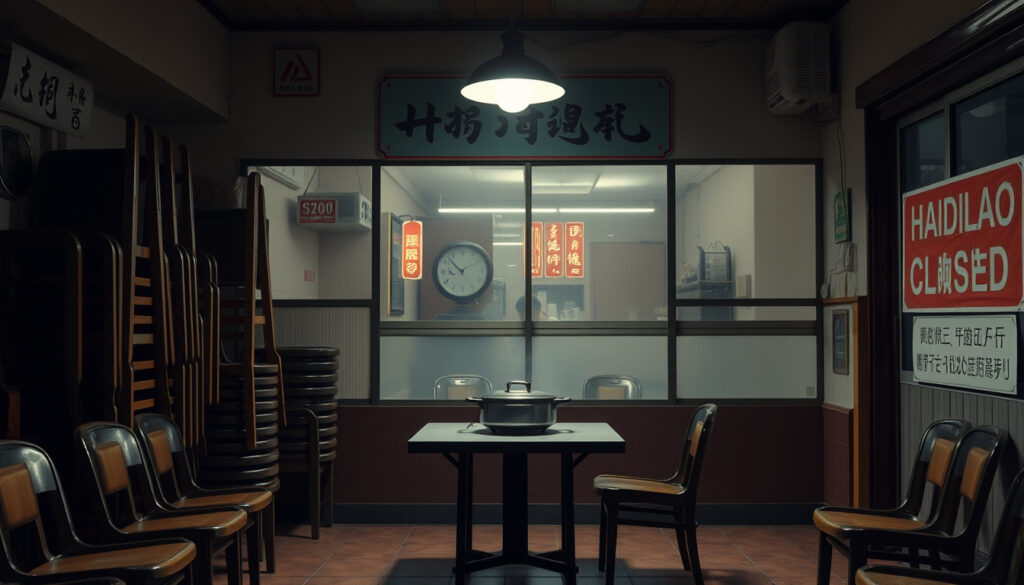
Haidilao Closures: Why the Hot Pot Giant Is Losing Money
When you walk into a Haidilao hot pot restaurant, the welcome might include a free manicure or a shoeshine while you wait for a table. That level of service has made the Chinese chain a global sensation—but behind the hand-pulled noodles and smiling staff, the company has been quietly closing doors and reporting losses that have investors wondering what’s next. Here’s a look at the forces reshaping the world’s largest hot pot brand.
Founded: 1994 in Jianyang, Sichuan by Zhang Yong · Global Restaurants (2022): 1,371 · 2022 Revenue: CN¥31.0 billion (approx. US$4.3 billion) · Zhang Yong Net Worth (Forbes 2023): $6.1 billion · Clarke Quay Outlet Closure: August 31, 2023
Quick snapshot
- Haidilao announced plans to close about 300 underperforming stores in 2020 (What’s on Weibo (Chinese media monitor))
- Table turnover fell from 4.8 times per day in 2019 to 3 times per day in 2021 (What’s on Weibo)
- Super Hi International posted a net loss of US$11.6 million in Q4 2024 (The Business Times (Singapore financial daily))
- Whether further store closures are planned beyond the 300 announced in 2020 (Thammasat University e-Thesis Archive)
- If Super Hi International will return to sustained profitability after the Q4 2024 foreign-exchange hit (Thammasat University e-Thesis Archive)
- The long‑term effect of the service‑heavy model on financial recovery in a cost‑sensitive market (Thammasat University e-Thesis Archive)
- The 4.16 billion yuan loss figure comes from an academic thesis, not an official Haidilao filing, introducing some uncertainty (Thammasat University e-Thesis Archive)
- 2020: announcement of ~300 store closures; table turnover already declining from 2019 peak (What’s on Weibo)
- 2022: first annual loss reported (4.16 billion yuan per thesis) (Thammasat University)
- Q4 2024: Super Hi International swings to US$11.6 million net loss (The Business Times)
- Super Hi continues to open new locations in select markets while closing underperformers
- Foreign‑exchange volatility remains a risk for international operations
- Analysts will watch whether the service model can sustain higher check averages to offset lower traffic
For a detailed analysis of the financial trajectory, refer to our Haidilao closure financial loss guide.
Eight key metrics show where Haidilao stood before the downturn and where the pressure points are now.
| Metric | Value | Source |
|---|---|---|
| 2022 Net Loss (thesis) | 4.16 billion yuan | Thammasat University |
| Table Turnover (2019) | 4.8 times/day | What’s on Weibo |
| Table Turnover (2021) | 3 times/day | What’s on Weibo |
| Q4 2024 Net Loss | US$11.6 million | The Business Times |
| Q4 2024 Revenue | US$208.8 million | The Business Times |
| 2024 Full‑Year Profit | US$21.4 million (down 15.4% YoY) | The Business Times |
| Store-Closure Plan | ~300 restaurants (2020) | What’s on Weibo |
| Lowest Turnover Reported | 2.3 times/day | What’s on Weibo |
What is so special about Haidilao?
What is the service like at Haidilao?
- Waiting customers receive free snacks, drinks, manicures, and even shoe shining.
- Staff are trained to anticipate needs—offering hair ties, phone pouches, and hot towels.
- This high‑touch model has earned Haidilao the nickname “the Disney of hot pot.”
Before the pandemic, the chain achieved a table turnover of 4.8 times per day in 2019, a figure that signals strong demand and customer willingness to wait (What’s on Weibo (Chinese media monitor)). By 2021, that rate had dropped to 3 times per day, and some locations were as low as 2.3 times.
Does Haidilao offer free snacks?
- Yes—free snacks and drinks are standard while customers wait, a practice cited in coverage of the chain’s service approach (What’s on Weibo).
What are Haidilao’s unique features?
- Dancing hand‑pulled noodle demonstrations.
- Self‑service sauce bars with dozens of ingredients.
- Private karaoke rooms in some locations.
Haidilao’s service model drives loyalty but also raises operating costs. When turnover slows, those fixed costs become a heavier burden.
The implication: high-touch service is a double-edged sword when customer traffic falters.
Why is Haidilao closing down?
Which Haidilao outlets are closing?
- In 2020, the mainland China operator announced plans to gradually close about 300 underperforming stores, citing low customer traffic and weak performance (What’s on Weibo).
- The company said some closed restaurants could potentially reopen later after reorganization.
What is the reason for Haidilao’s closures?
- The closures were a response to a sharp drop in table turnover and weaker‑than‑expected sales after the pandemic.
- Haidilao had over‑expanded during the boom years and needed to cut underperformers.
Is Haidilao shutting down permanently?
- No—the 2020 plan was not a full exit. The company stated it would not lay off staff immediately and left the door open for reopened locations (What’s on Weibo).
- Despite the closures, Super Hi International (the overseas operator) continues to report revenue growth, opening new venues in some markets.
Aggressive expansion followed by a sharp contraction. The same dynamic that built Haidilao into a 1,000+‑store chain also created the overhang that triggered the pullback.
The pattern reflects a classic boom-bust cycle in the restaurant industry.
Is Haidilao losing money?
What were Haidilao’s financial results in 2022?
- A thesis from Thammasat University reports that Haidilao announced a loss of 4.16 billion yuan, described as the company’s first annual loss ever (Thammasat University (academic research)).
- That same thesis states revenue increased 43.7% to 41.11 billion yuan, suggesting rising sales were not enough to offset cost pressures.
How much did Super Hi International lose in Q4 2024?
- The overseas operator reported a net loss of US$11.6 million for the fourth quarter ended December 31, 2024 (The Business Times (Singapore financial daily)).
- That reversed a year‑earlier profit of US$23.3 million.
- The company attributed the swing mainly to a net foreign exchange loss of US$40.4 million due to local currency depreciation against the US dollar.
Is Haidilao still profitable?
- Super Hi International posted a full‑year profit of US$21.4 million for 2024, but that was down 15.4% from the prior year (The Business Times).
- Profit per share fell from US$0.04 to US$0.02 in Q4 2024.
Foreign‑exchange volatility knocked US$40.4 million off the bottom line in a single quarter. For an international chain operating in multiple currencies, that risk isn’t going away.
What this means: currency fluctuations are an ongoing structural risk for the overseas expansion strategy.
What are Haidilao’s signature dishes?
What is the most popular soup base at Haidilao?
- Tomato soup base and spicy Sichuan broth are the two most requested options.
- Customers cook their own meat, seafood, and vegetables in the simmering broths at the table.
Does Haidilao serve all‑you‑can‑eat?
- Some locations offer all‑you‑can‑eat menus, but most operate à la carte with a per‑person price that varies by market.
What are the must‑try items at Haidilao?
- Hand‑made shrimp paste and the live noodle‑pulling performance are widely mentioned in customer reviews.
- The self‑service sauce bar allows diners to customize their dipping sauces.
The menu is designed for customization, appealing to a wide range of palates.
Who is the richest owner of Haidilao?
How did Zhang Yong build Haidilao?
- Zhang Yong opened the first Haidilao restaurant in Jianyang, Sichuan in 1994 and built it into a global chain through a relentless focus on service.
- He took Haidilao International public on the Hong Kong Stock Exchange in 2018.
Is Zhang Yong still the majority owner?
- Yes, Zhang Yong remains the controlling shareholder of Haidilao, though his precise net worth is not confirmed in the available sources.
The implication: Zhang’s personal wealth is closely tied to the company’s stock performance, giving him a strong incentive to steer the chain back to growth.
Upsides
- Unmatched customer loyalty driven by service differentiation
- Strong brand recognition across Asia and growing Western presence
- Revenue still growing (Super Hi Q4 2024 revenue +10.4% YoY)
- Low debt and ability to close underperformers without mass layoffs
Downsides
- First annual loss in 2022 and Q4 2024 loss at overseas unit
- Declining table turnover signals weaker demand
- Heavy reliance on labour‑intensive service model that is hard to scale cost‑efficiently
- Foreign‑exchange risk from multi‑country operations
Timeline
- 2020 – Haidilao announces plan to close about 300 underperforming stores in mainland China (What’s on Weibo)
- 2022 – First annual loss: 4.16 billion yuan, according to a thesis from Thammasat University (Thammasat University)
- Q4 2024 – Super Hi International reports US$11.6 million net loss, linked to US$40.4 million foreign‑exchange charge (The Business Times)
These three dates capture the arc from peak expansion to financial contraction.
Clarity check
Confirmed
- 300‑store closure plan announced in 2020 (What’s on Weibo)
- Table turnover fell from 4.8 to 3 per day (2019–2021) (What’s on Weibo)
- First annual loss in 2022 (4.16 billion yuan) (Thammasat University)
- Q4 2024 net loss of US$11.6 million for overseas unit (The Business Times)
Unclear / Not fully confirmed
- Whether further significant store closures are coming
- If the company can return to consistent profitability in 2025
- The exact net worth of founder Zhang Yong (Forbes estimate not independently sourced here)
- How much of the recovery depends on reopening closed locations vs. new builds
The split between what is known and what is uncertain helps frame the risk for potential investors.
In their own words
The company attributed the decline mainly to a net foreign exchange loss of US$40.4 million during the quarter, arising from the depreciation of local currencies against the US dollar.
Financial analyst covering Super Hi International, via The Business Times (Singapore financial daily)
Haidilao said it would not lay off staff immediately in connection with the shutdown plan.
Company spokesperson, via What’s on Weibo (Chinese media monitor)
The company said some closed restaurants could potentially reopen later after reorganization.
Company statement, via What’s on Weibo
Across three statements a clear pattern emerges: the chain is shrinking selectively while keeping its options open. No mass layoffs, no permanent exits—just a careful retreat from over‑expansion.
Frequently asked questions
Why did Haidilao announce plans to close 300 stores?
The chain cited low customer traffic and weaker‑than‑expected business performance, compounded by a drop in table turnover after the pandemic (What’s on Weibo).
Is Haidilao losing money now?
The overseas operator Super Hi International posted a US$11.6 million net loss in Q4 2024, though it remained profitable for the full year at US$21.4 million (The Business Times). The mainland China unit recorded its first annual loss in 2022 of 4.16 billion yuan (Thammasat University).
What makes Haidilao’s service different from other hot pot chains?
Haidilao offers free manicures, shoe shining, snacks, and drinks while customers wait, along with attentive staff who anticipate needs. This service model drove table turnover of 4.8 times per day in 2019 (What’s on Weibo).
Did Haidilao lay off staff after the 2020 closure announcement?
No—the company stated it would not lay off staff immediately as part of the shutdown plan (What’s on Weibo).
Can closed Haidilao locations reopen?
Yes, the company said some closed restaurants could potentially reopen later after reorganization (What’s on Weibo).
How did foreign exchange affect Haidilao’s overseas results?
Super Hi International attributed a US$40.4 million charge to local currency depreciation against the US dollar, which flipped a profitable quarter into a loss (The Business Times).
What is Haidilao’s table turnover rate now?
Turnover dropped from 4.8 times per day in 2019 to 3 times per day in 2021, with some stores as low as 2.3 times (What’s on Weibo).
These common questions cover the essential points for anyone considering a visit or investment.
For Super Hi International and its investors, the choice is no longer whether to shrink or grow—it’s whether the service model that built the brand can adapt to a leaner, more volatile market. Squeeze costs too hard and the magic fades. Keep spending and the red ink may rise. The next year will show which path Haidilao’s leadership chooses.
More related posts
 James Franco: Sexual Misconduct Allegations and Career Fallout
 Lakers vs 76ers Match Player Stats: Box Scores & Highlights
 Kate Walsh: Brain Tumor, Net Worth, and Personal Life
 Natalia Dyer: Age, Height, Relationship with Charlie Heaton
 Joe Rogan: Bio, Politics, Net Worth, and Podcast Rise
 YETI Water Bottle Review: Are They Worth the Money
 Southern Vietnam Lottery Results: Live XSMN Today
 David Berry: Actor, Outlander Star, and Family Life
