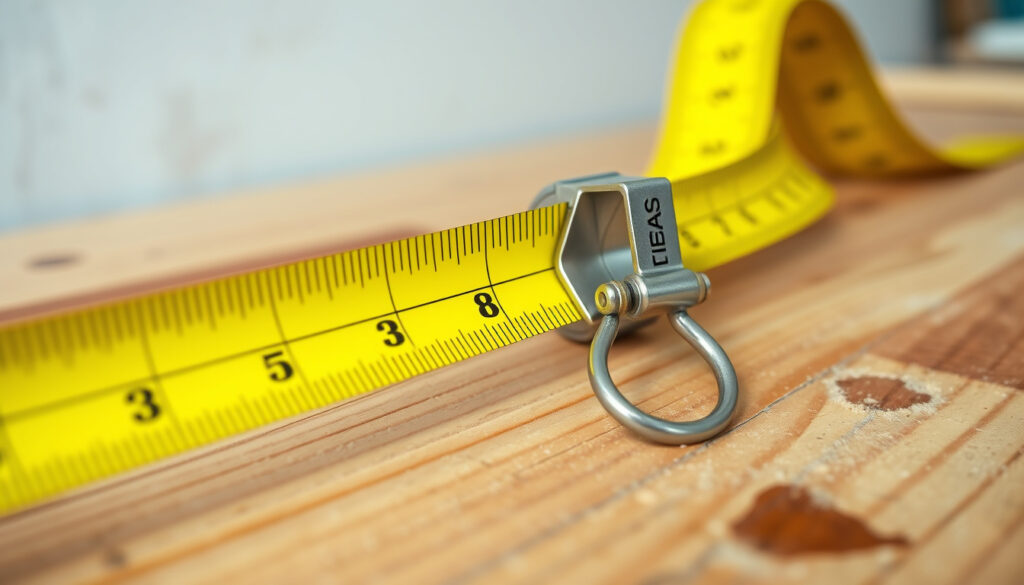
How to Read a Measuring Tape: Markings, Apps & More
Few tools in a toolbox see as much daily use as the humble tape measure. Whether you’re hanging a picture, checking furniture dimensions, or framing a wall, knowing how to read its markings—and when a smartphone app might be a decent stand-in—can save hours of guesswork. This guide walks through the essentials: what those tiny lines mean, how metric and imperial differ, and which tape measure to pick for your next project.
First tape measure patent: 1868 by Alvin J. Fellows · Standard blade width: 1 inch (25 mm) · Hook movement: 1/16 inch (1.6 mm) · Laser measure accuracy: ±1 mm up to 100 m · Common tape lengths: 1 m to 100 m
Quick snapshot
- Imperial markings divide each inch into 1/2, 1/4, 1/8, and 1/16 increments (Johnson Level (precision tool manufacturer))
- Metric side uses cm and mm; 1 cm = 10 mm (Kreg Tool (woodworking tool maker))
- Hook slides 1/16 in to compensate for its own thickness (Johnson Level (precision tool manufacturer))
- AR apps like Apple Measure achieve ~1% accuracy under good light (Apple Support)
- Not suitable for tasks requiring ±1 mm precision (Apple Support)
- Requires an iPhone with A9 chip or later for ARKit (Apple Support)
- A credit card is 85.6 mm × 53.98 mm (Wikipedia (ISO standard reference))
- A US dollar bill is 6.14 inches long (Wikipedia)
- A4 paper measures 210 mm × 297 mm (Wikipedia)
- 25 ft (7.5 m) with 1 in blade is most popular for general use (The Tape Store (specialist retailer))
- Standout of 7–10 ft is common for rigid blades (The Tape Store)
- Laser measures reach up to 100 m but struggle in bright sunlight (RS Components (industrial supplier))
Eight key facts about tape measures, from patent history to practical specs:
| Attribute | Value |
|---|---|
| First tape measure patent | 1868 (Alvin J. Fellows) (Wikipedia) |
| Standard tape measure blade width | 1 inch (25 mm) (The Tape Store (specialist retailer)) |
| Hook movement allowance | 1/16 inch (1.6 mm) (Johnson Level (precision tool manufacturer)) |
| Maximum length (manual tape) | 25 ft (7.5 m) common; up to 100 m for lasers (RS Components (industrial supplier)) |
| Accuracy of smartphone AR measuring apps | Approximately 1% under ideal conditions (Apple Support) |
| Imperial divisions per inch | Most tape measures divide to 1/16 (16 marks per inch) (REEKON Tools (tape measure manufacturer)) |
| EC Class I max error (10 m) | 1.1 mm (RS Components (industrial supplier)) |
| Common standout distance | 7–10 ft (2.1–3.0 m) (The Tape Store (specialist retailer)) |
How do I read a measuring tape?
Reading a tape measure is a skill that pays off every time you cut a board or hang a shelf. The key is understanding that the longest lines mark whole inches, and progressively shorter lines mark fractions.
Identifying the main markings: inches, half-inches, quarter-inches, eighths, sixteenths
- The longest line is the inch mark. The second-longest is the half-inch (1/2). (Johnson Level (precision tool manufacturer))
- Between the half-inch marks, the next-longest lines are quarter-inches (1/4 and 3/4). (Johnson Level (precision tool manufacturer))
- Shorter still are eighth-inch marks (1/8, 3/8, 5/8, 7/8), and the shortest common lines are sixteenths. (REEKON Tools (tape measure manufacturer))
The pattern: each level is half the previous. Memorising that simple hierarchy turns a confusing grid into a logical scale.
How to identify 1 inch on a tape measure
The inch mark is the longest line on the imperial edge. Every inch is numbered with a large numeral. On many tapes, inch marks are also highlighted in red every 16 inches to indicate standard stud spacing (Love & Renovations (DIY home improvement blog)).
Reading metric side: centimeters and millimeters
On a dual-scale tape, the metric side uses centimeters (cm) for the longer marks and millimeters (mm) for the smallest lines. Ten millimeters make one centimeter. To read, find the whole centimeter number, then count the mm lines after it (Kreg Tool (woodworking tool maker)).
Misreading just one 1/16 inch mark compounds quickly: a wall that’s off by 1/8 inch over eight feet creates a 1-inch gap at the far end. Knowing the fractions is the difference between a tight joint and a shim-filled mess.
The implication: mastering the hierarchy of marks prevents costly errors in any project.
Can I use my phone as a tape measure?
Smartphones can measure distances using augmented reality (AR), but they come with trade-offs that might surprise you.
How augmented reality (AR) measuring apps work
AR apps like Apple’s Measure use the camera and motion sensors to detect flat surfaces and calculate dimensions. Apple’s Measure requires an iPhone with an A9 or later chip and works with ARKit (Apple Support). The app projects a virtual tape onto the screen and reads real-world distances.
Accuracy limitations of smartphone measurement
Under ideal lighting and on a flat surface, AR measurements can be within about 1% accuracy. That means a 10-foot measurement could be off by 1.2 inches (Apple Support). For woodworking or tight installations where ±1 mm is critical, that margin is too wide.
Top phone measuring apps (iOS and Android)
- Apple Measure – built into iOS, free, uses ARKit (Apple Support)
- Google Measure – similar AR tool for Android (limited device support)
- Moasure – uses motion sensors to measure distance, angle, and level (available on iOS and Android)
The trade-off: A phone is great for rough room dimensions or estimating furniture size, but for any job where the cut must fit, a steel tape is still the right tool.
Does measuring tape use cm or mm?
Both—it depends on which side of the tape you look at.
Which side of measuring tape is cm?
Most dual-scale tape measures show the imperial scale (inches) on the top edge and the metric scale (centimeters and millimeters) on the bottom edge. The metric side at 150 mm, for example, shows “15” (15 cm) with ten tiny lines after it representing millimeters (Kreg Tool (woodworking tool maker)).
Is it 20mm or 20 mm? Correct usage of the metric system
The International System of Units (SI) prescribes a space between the number and the unit: “20 mm” not “20mm” (Wikipedia (SI standard reference)). Although many labels and product specs drop the space, the correct form improves readability and avoids ambiguity in technical documents.
Converting between imperial and metric markings
1 inch = 25.4 mm exactly (Wikipedia). To convert inches to cm, multiply by 2.54. For quick reference, a 1-inch mark on a metric tape corresponds to 2.54 cm—roughly halfway between the 2 cm and 3 cm marks.
What can I use if I don’t have a measuring tape?
When you’re caught without a tape, everyday objects can fill the gap.
Everyday objects with known lengths
- A standard credit card is 85.6 mm × 53.98 mm (Wikipedia (ISO standard reference)).
- A US dollar bill is 6.14 inches long (Wikipedia).
- A4 paper measures 210 mm × 297 mm (Wikipedia).
- A standard sheet of letter paper (8.5 × 11 in) is exactly that.
Using a ruler or yardstick as a substitute
A ruler is the simplest alternative—just align the zero mark with the starting point and read the end. Yardsticks and meter sticks offer longer reach without needing to hook onto edges.
DIY paper tape measure printable
Many websites offer printable tape measures that you can cut out and tape together. These are fine for rough estimates but lack the hook compensation and durability of a steel tape.
How to choose a measuring tape
Picking the right tape measure depends on the job, not just the price tag.
Tape measure lengths: which is right for your project?
- 12–16 ft (3.6–4.8 m): ideal for small DIY projects and toolboxes.
- 25 ft (7.5 m): the most popular general-use length (The Tape Store (specialist retailer)).
- 35–100 ft (10.6–30 m): used for construction and outdoor work.
Blade width and standout – why it matters
A 1-inch blade is standard for 25 ft tapes. Standout—how far the blade extends without buckling—ranges from 7 to 10 ft on quality tapes (The Tape Store (specialist retailer)). A wider blade improves standout.
Digital vs. analog tape measures: pros and cons
Digital tapes show a numeric readout but still rely on a physical blade. They eliminate misreading fractions but require batteries and cost more. Analog tapes are reliable, cheap, and work in all weather.
Laser tape measures for long distances
Laser measures can reach up to 100 m with ±1 mm accuracy, but performance drops in bright sunlight (RS Components (industrial supplier)). They are excellent for room dimensions and real estate measurements but less useful for short, precise cuts.
For 90% of DIY jobs, a mid-range 25 ft tape with a 1-inch blade and a 7 ft standout is all you need. Professionals working in tight tolerances should look for Class I accuracy, while laser measures shine for long, straight distances.
Here is a comparison of the three measurement methods.
| Specification | Manual Tape (25 ft) | Laser Tape | Phone AR App |
|---|---|---|---|
| Typical length | 25 ft (7.5 m) | Up to 100 m | Unlimited (view-dependent) |
| Accuracy | ±1/16 in per 10 ft | ±1 mm up to 100 m | ~1% (varies) |
| Works in bright light | Yes | Reduced | Reduced |
| Battery required | No | Yes | Yes (phone) |
| Cost (approx) | $10–$30 | $30–$150 | Free (if phone owned) |
Three measurement methods, one clear pattern: the manual tape remains the most versatile for everyday precision work.
Steps to Measure Accurately with a Tape Measure
- Hook the end: For an inside measurement (e.g., wall to wall), push the hook against one surface. The hook’s 1/16-inch movement compensates for its thickness (Johnson Level (precision tool manufacturer)). For an outside measurement (e.g., around a pipe), hook the lip over the edge.
- Extend the tape: Pull the blade taut but not overstretched. A bowed blade adds length.
- Read the whole units: Look at the nearest whole inch or centimeter mark. Write that number down.
- Count the fraction: Count the smaller lines after the whole unit. On an imperial tape, each line past the inch is 1/16 inch (if divided into 16). On a metric tape, each small line is 1 mm.
- Add them up: Whole + fraction = final measurement. Double-check by reading from the opposite end if possible.
For body measurements (e.g., waist or chest), use a soft tape or a paper tape printed from a template—metal tapes can be uncomfortable and less flexible.
Timeline: Key milestones in tape measure evolution
- 1868: Alvin J. Fellows patents the first spring-loaded tape measure in the United States (Wikipedia).
- 1920s: Hiram A. Farrand patents the “pull out and lock” mechanism, the basis for modern retractable tapes (Wikipedia).
- 1940s: Stanley Tools introduces the “Powerlock” tape measure with a blade lock button (Stanley Tools (manufacturer)).
- 2000s: Laser tape measures become affordable for consumers, enabling non-contact measurement up to 100 m (RS Components (industrial supplier)).
- 2017: Apple introduces the Measure app with iOS 12, using ARKit to turn iPhones into measuring tools (Apple Support).
From a spring-loaded clip to a pocket computer, the tape measure kept its core job: telling you exactly how long something is.
What we know and what remains unclear
Confirmed facts
- The hook on a standard tape measure is designed to move 1/16 inch (1.6 mm) to compensate for its thickness (Johnson Level (precision tool manufacturer)).
- 1 inch = 25.4 mm exactly (Wikipedia).
- A standard credit card width is 85.6 mm (Wikipedia (ISO standard reference)).
- EC Class I tape measures have a maximum error of 1.1 mm over 10 metres (RS Components (industrial supplier)).
What’s unclear
- The exact accuracy of smartphone AR measuring apps varies by device and lighting conditions (Apple Support).
- Whether a laser tape measure is more accurate than a high-quality manual tape measure depends on the specific model and range (RS Components (industrial supplier)).
The pattern: the more you know about your tool’s tolerances, the better you can judge when to trust it.
“The hook’s 1/16-inch slide is not a flaw—it’s a feature. It ensures that when you push against a wall, your measurement starts exactly at the end of the blade.”
Johnson Level (precision tool manufacturer)
“Tape measures used in commerce must meet specified tolerance classes to ensure fairness in trade. Class I is the highest precision, with errors not exceeding 1.1 mm over 10 metres.”
NIST Handbook 44 (US national metrology institute)
“The Measure app provides a convenient approximate measurement but should not be relied upon for tasks requiring high precision, such as cutting materials.”
Apple Support (official product documentation)
Three authoritative voices, one message: know your tool’s limitations before you trust its reading.
For DIYers and professionals alike, the choice between a manual tape measure and a digital alternative comes down to the job. If you need ±1 mm accuracy in bright sunlight, a Class I steel tape is your safest bet. If you’re measuring room dimensions in a tight corner, a laser tool saves time. Know your markings, know your tolerances, and the right tool becomes obvious.
en.wikipedia.org, blog.reekon.tools, youtube.com, perfectmeasuringtape.com, mamaandmore.com, youtube.com
För att undvika mätfel när du använder digitala verktyg kan du läsa mer om noggrannhet och telefonappar.
Frequently asked questions
How do you measure a diagonal with a tape measure?
Place the hook at one corner, extend the tape diagonally to the opposite corner, and read the measurement. For large diagonals, a laser measure is easier.
What is the proper way to hold a tape measure to avoid bending?
Hold the tape body in your palm and use your thumb to press the blade against the surface. Avoid pulling the blade at an angle—keep it straight.
How to prevent the tape measure blade from breaking?
Always let the blade retract slowly. Never let it snap back, as that can cause the tip to break or weaken the spring.
Why does the tape measure have a small hole on the hook?
The hole lets you hook onto a nail or screw head for one-handed measurements (Johnson Level (precision tool manufacturer)).
How to read a tape measure without numbers?
Tapes without numbers are rare but can be read by counting the marks from the zero point. Alternately, use the known length of a body part (e.g., hand span) as a reference.
What is the belt clip on a tape measure used for?
It attaches to a belt for quick access. Most tapes come with a removable clip.
How to clean and maintain a tape measure?
Wipe the blade with a dry cloth to remove grit. Apply a light oil to the spring mechanism if it starts to stiffen. Store in a dry place.
More related posts
 Liam Payne Death: Cause, Investigation, and Aftermath
 Enid Blyton: Controversy, Famous Books & Legacy
 Microsoft Outlook Login: Sign In Guide & Fixes
 2024 Toyota C-HR Price, Specs, Common Problems & RAV4
 Luke Beveridge: AFL Career, Coaching, Salary, and Personal Life
 JFK Jr. Plane Crash: Cause, NTSB Report, Key Facts
 Iget Bar Pro – 10000 Puffs Specs Flavors and Guide
 CatDog: What It Is, Why Canceled, and Hybrid Reality
