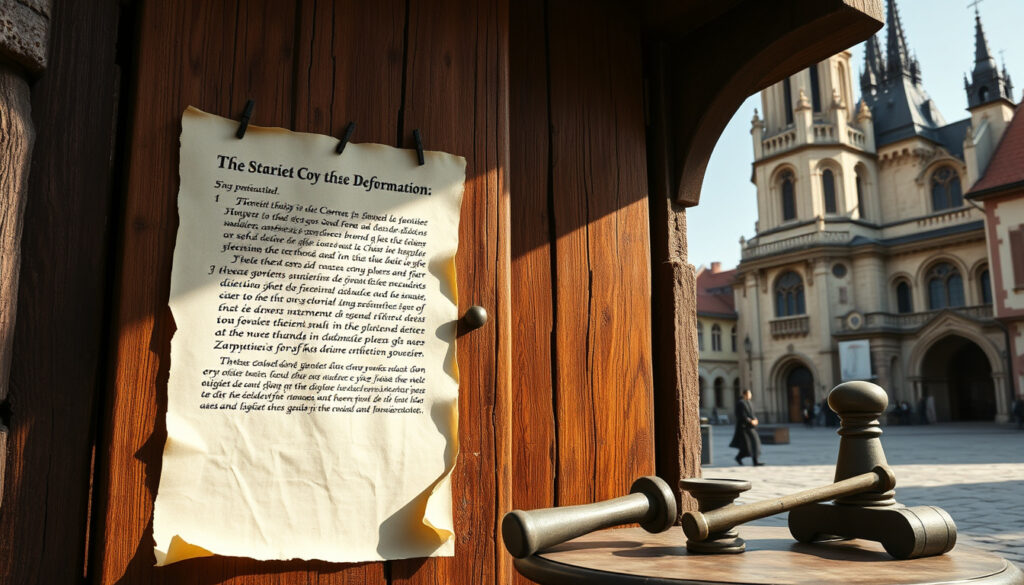
Martin Luther: Biography, 95 Theses, and the Protestant Reformation
It’s rare that a single document changes the course of history, but Martin Luther’s 95 Theses did exactly that. When he challenged the sale of indulgences in 1517, Luther sparked a religious upheaval that split Western Christianity and reshaped Europe — and this article walks through his life, his core teachings, and how one monk’s conscience ignited the Protestant Reformation.
Born: 10 November 1483, Eisleben, Germany ·
Died: 18 February 1546, Eisleben, Germany ·
Known for: 95 Theses (1517) sparking the Protestant Reformation ·
Major work: Translation of the Bible into German ·
Denomination founded: Lutheranism ·
Key doctrine: Justification by faith alone (sola fide)
Quick snapshot
- Luther posted the 95 Theses in 1517, an act widely accepted as the start of the Reformation (Britannica (historical encyclopedia))
- He was excommunicated in 1521 (Britannica (historical encyclopedia))
- He translated the Bible into German (Britannica (historical encyclopedia))
- He died on 18 February 1546 (Britannica (historical encyclopedia))
- The exact date of posting the 95 Theses (31 October is traditional, but it may have been November) (Britannica (historical encyclopedia))
- Whether Luther literally nailed the theses to the door or mailed them; both accounts exist (Wikipedia (community encyclopedia))
- The precise wording of his final statement as a single, undisputed quotation (Britannica (historical encyclopedia))
- Whether Luther actually said “Here I stand” at the Diet of Worms – historicity debated (Wikipedia (community encyclopedia))
- 31 October 1517: 95 Theses posted (Britannica (historical encyclopedia))
- 1521: Excommunication and Diet of Worms (Britannica (historical encyclopedia))
- 1525: Marriage to Katharina von Bora (Britannica (historical encyclopedia))
- 1534: Complete German Bible published (Britannica (historical encyclopedia))
- Luther’s legacy continues through the Lutheran Church, which now has about 70 million members worldwide (Britannica (historical encyclopedia))
- Reformation Day (31 October) remains an official religious holiday in parts of Germany (Britannica (historical encyclopedia))
- Modern scholarship continues to debate the exact circumstances of the posting (Wikipedia (community encyclopedia))
Eight key facts about Luther, one pattern: his life was a series of pivotal moments that each deepened the break with Rome.
| Full name | Martin Luther |
|---|---|
| Born | 10 November 1483 |
| Birthplace | Eisleben, Saxony, Holy Roman Empire |
| Died | 18 February 1546 |
| Known for | 95 Theses, initiating the Protestant Reformation |
| Key publication | 95 Theses (1517), On the Freedom of a Christian (1520) |
| Spouse | Katharina von Bora |
| Major influence | Augustine of Hippo, Paul the Apostle |
What was Martin Luther most famous for?
The 95 Theses and the Indulgence Controversy
- Luther wrote the Ninety-five Theses in 1517 as propositions for debate concerning indulgences (Britannica (historical encyclopedia)).
- The theses criticized the sale of indulgences and asserted that scripture should be the primary source of spiritual authority (EBSCO Research Starters (academic research database)).
- Tradition says Luther posted the theses on the door of the Castle Church in Wittenberg (Britannica (historical encyclopedia)).
The posting and publication of the theses is widely treated as the beginning of the Protestant Reformation (Britannica (historical encyclopedia)).
Luther’s theses turned a local academic complaint into a Europe-wide crisis because print technology let them spread faster than the Church could respond. Within months, the indulgence debate became a test of papal authority.
The implication: The rapid spread of the theses forced the Church to confront a challenge that would cleave Christendom in two.
The Spark of the Reformation
- The indulgence controversy was central to Luther’s criticism of church practice (Library of Congress (U.S. federal research library)).
- The theses spread rapidly through print and gained popular momentum beyond Luther’s expectations (Library of Congress (U.S. federal research library)).
- By 1520 Pope Leo X demanded that Luther retract his views (Wikipedia (community encyclopedia)).
The pattern: What began as an academic invitation to debate escalated into a full-blown confrontation because Luther refused to back down, and the printing press ensured his arguments reached audiences far beyond Wittenberg.
Why did Martin Luther break away from the Catholic Church?
Theological Disagreements: Sola Scriptura and Sola Fide
- Luther rejected papal supremacy and church tradition as equal to scripture (Britannica (historical encyclopedia)).
- He advocated justification by faith alone (sola fide) (Britannica (historical encyclopedia)).
- Salvation, he argued, comes through faith, not good works (EBSCO Research Starters (academic research database)).
The Role of Papal Authority
- Luther maintained that the Bible is the sole source of religious authority (sola scriptura) (Britannica (historical encyclopedia)).
- He was excommunicated in 1521 after refusing to recant (Britannica (historical encyclopedia)).
The Diet of Worms and the Edict of Worms
- Luther appeared before the Diet of Worms in 1521 (Britannica (historical encyclopedia)).
- The resulting Edict of Worms declared him a heretic and an outlaw of the Empire (Wikipedia (community encyclopedia)).
The trade-off: By rejecting both the Pope’s authority and the Emperor’s ultimatum, Luther lost the protection of the Church and the state — but gained support from German princes who saw political and economic advantage in breaking from Rome.
What were Luther’s three main ideas?
Sola Scriptura (Scripture Alone)
- Luther argued the Bible is the sole source of religious authority (Britannica (historical encyclopedia)).
- He rejected church councils and papal decrees as equal to scripture (Britannica (historical encyclopedia)).
Sola Fide (Faith Alone)
- Salvation comes through faith, not good works (EBSCO Research Starters (academic research database)).
- This doctrine became a cornerstone of Lutheranism (Britannica (historical encyclopedia)).
The Priesthood of All Believers
- All believers have direct access to God without priestly mediation (Britannica (historical encyclopedia)).
- This idea effectively abolished the distinction between clergy and laity in matters of grace (EBSCO Research Starters (academic research database)).
These three pillars — Bible alone, faith alone, and universal priesthood — gave ordinary Christians a reason to doubt Church authority and a blueprint for a new kind of Christianity.
The pattern: Each principle shifted the locus of religious authority from the institution to the individual, empowering lay believers to read and interpret scripture for themselves.
What were Luther’s dying words?
The Historical Account of Luther’s Final Hours
- Luther died in Eisleben on 18 February 1546 (Britannica (historical encyclopedia)).
- His last written statement was in Latin and German (Britannica (historical encyclopedia)).
- The phrase includes “We are beggars. This is true.” (Wikipedia (community encyclopedia))
Meaning of His Final Statement
Luther’s last words reflect his lifelong emphasis on grace: even a reformer who challenged the most powerful institution of his era saw himself as nothing more than a beggar before God. The exact wording, however, remains debated among scholars (Britannica (historical encyclopedia)).
What this means: In his final moments, Luther returned to the core of his theology — that human effort counts for nothing, and everything depends on God’s mercy.
What are 5 facts about Martin Luther?
He Was a Monk and a Theologian
- Luther was an Augustinian monk and a university professor at Wittenberg (Britannica (historical encyclopedia)).
- He received his doctorate in theology in 1512 (Britannica (historical encyclopedia)).
He Translated the Bible into German
- His German Bible translation shaped the German language (Britannica (historical encyclopedia)).
- He published the complete German Bible in 1534 (Britannica (historical encyclopedia)).
He Married a Former Nun
- He married Katharina von Bora in 1525 (Britannica (historical encyclopedia)).
- Their marriage set the model for Protestant clergy families (Britannica (historical encyclopedia)).
He Wrote Hymns
- He wrote “A Mighty Fortress Is Our God” (Britannica (historical encyclopedia)).
- Congregational singing became a hallmark of Lutheran worship (EBSCO Research Starters (academic research database)).
His Legacy Is the Lutheran Church
- Lutheranism became the first major Protestant denomination (Britannica (historical encyclopedia)).
- Today the Lutheran World Federation represents about 70 million members (Britannica (historical encyclopedia)).
The takeaway: His marriage and hymns humanized the Reformation, proving that reform could be personal and communal, not just doctrinal.
What did Martin Luther do in Christianity?
Challenged the Catholic Church’s Authority
- Luther’s challenge led to a permanent schism in Western Christianity (Britannica (historical encyclopedia)).
- The Protestant Reformation split Christianity into Roman Catholic and Protestant branches (Britannica (historical encyclopedia)).
Established Core Protestant Doctrines
- He developed the theological foundation for Lutheranism (Britannica (historical encyclopedia)).
- His ideas influenced Calvin, Zwingli, and other reformers (EBSCO Research Starters (academic research database)).
Initiated the Protestant Reformation
- His actions sparked a broader movement across Europe (Britannica (historical encyclopedia)).
- The Reformation altered the political map of Europe, as princes and territories chose sides (Library of Congress (U.S. federal research library)).
The implication: Luther didn’t merely criticize the Church — he gave birth to a new way of being Christian that emphasized personal faith, scripture reading, and congregational worship. That model spread across the Atlantic and eventually shaped the global Protestant landscape.
Timeline: Martin Luther’s Life and Legacy
The timeline below organizes Luther’s life into decisive moments.
| Date | Event |
|---|---|
| 10 November 1483 | Martin Luther born in Eisleben, Germany (Britannica (historical encyclopedia)) |
| 1501 | Enters the University of Erfurt (Britannica (historical encyclopedia)) |
| 1505 | Joins the Augustinian monastery (Britannica (historical encyclopedia)) |
| 1512 | Receives doctorate in theology; becomes professor at Wittenberg (Britannica (historical encyclopedia)) |
| 31 October 1517 | Posts the 95 Theses on indulgences (Britannica (historical encyclopedia)) |
| 1521 | Excommunicated by Pope Leo X; Diet of Worms (Britannica (historical encyclopedia)) |
| 1525 | Marries Katharina von Bora (Britannica (historical encyclopedia)) |
| 1534 | Publishes his complete German translation of the Bible (Britannica (historical encyclopedia)) |
| 18 February 1546 | Dies in Eisleben (Britannica (historical encyclopedia)) |
Confirmed facts
- Luther posted the 95 Theses in 1517, an act widely accepted as the start of the Reformation (Britannica (historical encyclopedia))
- He was excommunicated in 1521 (Britannica (historical encyclopedia))
- He translated the Bible into German (Britannica (historical encyclopedia))
- He died on 18 February 1546 (Britannica (historical encyclopedia))
What remains unclear
- Exact date of posting the 95 Theses (31 October traditional, but may be November) (Britannica (historical encyclopedia))
- Whether Luther nailed or mailed the theses (Wikipedia (community encyclopedia))
- Precise wording of his final statement (Britannica (historical encyclopedia))
- Historicity of the “Here I stand” speech at Worms (Wikipedia (community encyclopedia))
Quotes from Luther and His Era
“We are beggars. This is true.”
— Martin Luther, final written statement, 1546 (Wikipedia (community encyclopedia))
“Unless I am convinced by the testimony of the Scriptures or by clear reason — for I do not trust either in the pope or in councils alone, since it is well known that they have often erred and contradicted themselves — I am bound by the Scriptures I have quoted and my conscience is captive to the Word of God.”
— Martin Luther, statement at the Diet of Worms, 1521 (attributed) (Wikipedia (community encyclopedia))
“The theses became a manifesto that turned an indulgence protest into a major crisis in Western Christianity.”
— Britannica (historical encyclopedia) (Britannica (historical encyclopedia))
For readers interested in other figures from the same era, see Anne Boleyn (whose execution was tied to the English Reformation) and Marco Polo, another major historical figure whose travels reshaped global perspectives.
Martin Luther’s break with Rome was never just a theological dispute — it was a revolution in how people read the Bible, related to the church, and saw themselves. For anyone studying the roots of modern individualism, vernacular literacy, or church-state relations, the monk from Wittenberg remains an unavoidable starting point. His legacy is written into the very structure of Western Christianity.
protestantism.co.uk, exhibits.lib.arizona.edu, youtube.com, britannica.com, christianhistoryinstitute.org, christianhistoryinstitute.org
For a detailed look at his early life and the events that sparked the Reformation, see Martin Luthers biography and 95 Theses.
Frequently asked questions
What is the Protestant Reformation?
The Protestant Reformation was a 16th-century split in Western Christianity that began with Martin Luther’s 95 Theses in 1517 (Britannica (historical encyclopedia)). It led to the creation of Protestant churches separate from the Roman Catholic Church.
Did Martin Luther translate the Bible?
Yes, Luther translated the Bible into German. His complete translation was published in 1534 and had a lasting impact on the German language (Britannica (historical encyclopedia)).
How did Martin Luther’s actions change the Catholic Church?
Luther’s challenge forced the Catholic Church to respond with the Counter-Reformation, which included the Council of Trent (1545–1563) that clarified Catholic doctrine and reformed abuses (Britannica (historical encyclopedia)).
What does ‘sola fide’ mean?
‘Sola fide’ is Latin for ‘faith alone’. It was Luther’s teaching that salvation comes through faith in Jesus Christ, not through good works (EBSCO Research Starters (academic research database)).
Why was Martin Luther excommunicated?
Luther was excommunicated in 1521 after he refused to recant his views on indulgences, papal authority, and salvation (Britannica (historical encyclopedia)).
What was the impact of Luther’s marriage?
Luther’s marriage to Katharina von Bora in 1525 set an example for Protestant clergy to marry, breaking centuries of mandatory celibacy for priests (Britannica (historical encyclopedia)).
Where was Martin Luther born?
Martin Luther was born in Eisleben, Saxony, Holy Roman Empire (modern-day Germany) on 10 November 1483 (Britannica (historical encyclopedia)).
More related posts
 Ethel Kennedy: Life, Children, and Human Rights Legacy
 Brandon Thomas Lee: From Reality TV to Emmy-Nominated Producer
 Bow Wow Biography: Net Worth, Height, Age, and Facts
 Pak vs NZ Abandoned by Rain: T20 World Cup Super 8s
 The Orchard Penrith – Family-Friendly Riverside Dining Guide
 Stassi Schroeder: Husband, Net Worth, and Vanderpump Comeback
 Southern Vietnam Lottery Results: Live XSMN Today
