Oyster Farmers: Profit, Sustainability & Industry Guide
There’s a quiet revolution happening in the shallow bays along Ireland’s west coast, and it involves oysters. Oyster farmers are balancing tradition, ecology, and profit in an industry that generated an estimated €64.45 million in 2022, according to a Nature study (peer-reviewed research). This guide covers how oysters are farmed, what it takes to become an oyster farmer, and why Ireland has become a key player in the global oyster market.
Type of farming: Aquaculture (mariculture) ·
Primary products: Meat, pearls, shells ·
Common methods in Ireland: Trestle and rack systems ·
Sustainability certification: ASC (Aquaculture Stewardship Council)
Quick snapshot
- Oyster farming is a form of aquaculture (Trinity College Dublin (university research))
- Ireland has many oyster farms, mostly on the west coast (Trinity College Dublin)
- Farmed oysters are generally safe to eat when properly handled (Irish Farmers’ Association (industry guidance))
- Exact profitability numbers vary widely by location and method
- Long-term environmental impact of large-scale oyster farming
- Percentage of oysters farmed vs wild globally
- 2025 Nature study estimates Irish oyster farming income at €64.45 million (Nature (peer-reviewed journal))
- French markets account for 75% of Irish oyster exports (Bord Bia (Irish food board))
- EU lists Pacific oyster as a main reared species in Ireland (European Union Aquaculture (official database))
- Nutrient credits could reduce production costs and boost profitability (Nature)
- Rising interest in alternative systems like floating bags (IFA 2025 guide)
- Farm tours and agritourism are becoming part of the business model (Irish Premium Oysters (farm operator))
Four key facts about oyster farming at a glance.
| Label | Value |
|---|---|
| Alternate names | Oyster aquaculture, oyster growing |
| Primary methods | Bottom culture, rack and bag, longline |
| Leading region | West coast of Ireland |
| Ideal water conditions | Clean, saline, sheltered bays |
| Export market | France (75% of Irish oyster exports) (Bord Bia) |
| Income (2022) | €64.45 million (Nature) |
| Production costs (2022) | €41.19 million (Nature) |
| Nutrient removal value | ~€1.9 million per year (Nature) |
Can oysters be farmed?
Oysters have been farmed for centuries, and today it’s a well-established branch of aquaculture. The practice involves breeding and raising oysters in controlled environments to produce meat, pearls, and shells.
What is oyster farming?
- Oyster farming is an aquaculture practice where oysters are bred and raised for harvest (Trinity College Dublin).
- It includes three main cultivation approaches in Ireland: bottom culture on beds, trestle/bag culture above the seabed, and tank-based maturation systems (Trinity College Dublin).
- The European Union lists Pacific oyster (Crassostrea gigas) and native oyster (Ostrea edulis) among the main reared species in Ireland (European Union Aquaculture).
How does oyster farming work?
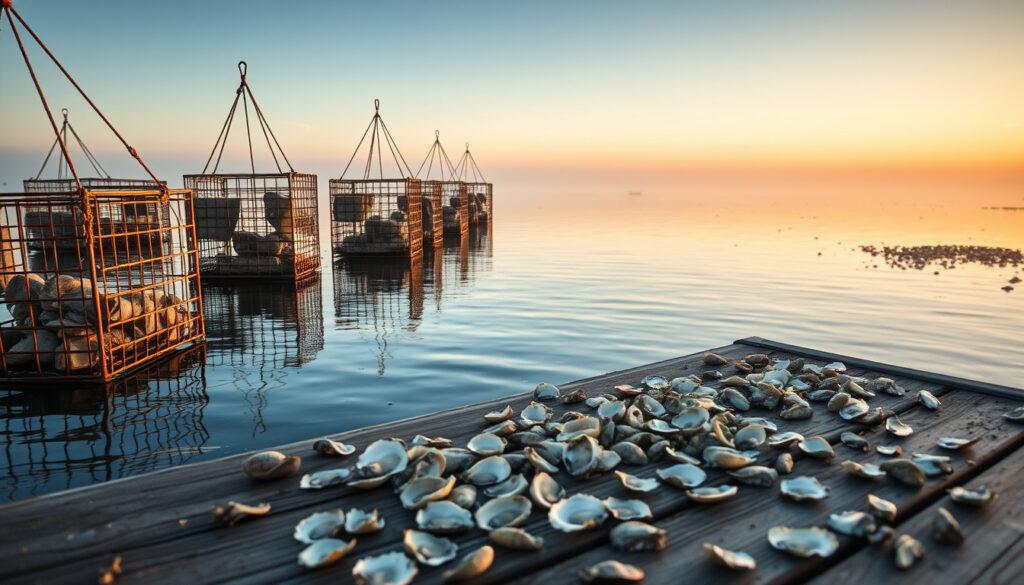
Bottom culture involves distributing spat or seed over existing beds and harvesting them with methods similar to wild oyster harvesting, commonly dredging (Trinity College Dublin). Trestle, rack, bag, basket, cage, or rope-based systems keep oysters above the bottom and are harvested by lifting the enclosure to the surface or collecting oysters at low tide (Trinity College Dublin).
Tank maturation systems are the least susceptible to predators and poaching, but they are the most expensive and labour intensive to build, manage, and operate (Trinity College Dublin).
The implication: most Irish oyster farmers stick with methods one and two, relying on sheltered bays along the west coast and Atlantic water conditions (Trinity College Dublin).
Are oysters farmed in Ireland?
Yes, oyster farming is a significant part of Ireland’s aquaculture sector. The west coast, with its many sheltered bays, provides ideal conditions for growing oysters.
Oyster farming regions in Ireland
- Most Irish oyster farmers use trestle and rack methods, taking advantage of the Atlantic water quality (Trinity College Dublin).
- The IFA 2025 good practice guide confirms that most C. gigas in Ireland are grown in bags on trestles (Irish Farmers’ Association).
- Bord Bia notes that Irish oyster growers combine modern technology with traditional hand-harvesting methods to produce top-quality oysters (Bord Bia).
Top oyster farms in Ireland
DK Connemara Oysters operates in Ballinakill Bay and markets farm tours and direct sales (DK Connemara Oysters (farm operator)). Irish Premium Oysters also promotes guided tours and tastings as part of its customer experience (Irish Premium Oysters).
Why this matters: Ireland’s clean waters and established farming techniques give it a strong position in the European oyster market, especially with France importing 75% of Irish oyster exports (Bord Bia).
What do you call an oyster farm?
Oyster farms go by several names, and the terminology can be confusing for newcomers.
Common terms: oyster farm, oyster bed, oyster hatchery
- Oyster farms can be called oyster beds or oyster farms, used interchangeably in most contexts (Trinity College Dublin).
- Hatcheries produce seed oysters (spat) that are then transferred to grow-out sites on farms (European Union Aquaculture).
- The term “oyster aquaculture” is the official scientific and regulatory name (Irish Farmers’ Association).
Differences between farm types
Bottom culture farms use existing seabed beds, while trestle and bag farms keep oysters off the bottom. Tank-based systems are fully controlled environments. The choice affects cost, labor, and risk from predators.
The pattern: the name often reflects the method — “bed” for bottom culture, “farm” for trestle/rack operations, and “hatchery” for the seed production stage.
How profitable is oyster farming?
Profitability in oyster farming depends heavily on location, scale, method, and market access. The numbers show a clear picture for Ireland.
Profit margins
A 2025 study in Nature estimated that Irish oyster farming industry income in 2022 was about €64.45 million, with production costs of about €41.19 million. That leaves a gross margin of roughly €23 million across the sector. The study also estimated a nutrient removal value of about €1.9 million per year, which could offset some costs.
Startup costs
Oyster farming requires significant upfront investment. A trestle and bag setup involves purchasing trestles, bags, boats, and seed oysters. The IFA 2025 guide recommends keeping in-bag stocking densities as low as possible and maximizing spacing between trestles to maintain oyster health, which affects the number of oysters per area and thus potential revenue.
Revenue streams from meat, pearls, tours
- Meat sales: primary revenue, with French markets accounting for 75% of Irish exports (Bord Bia).
- Pearls: a niche product, but not a major revenue stream for most Irish farms.
- Farm tours: Irish Premium Oysters and DK Connemara Oysters offer tours, adding a direct-to-consumer income stream (Irish Premium Oysters; DK Connemara Oysters).
Nutrient credits could reduce production costs, provide investment capital, and support marketing to expand profitability, according to the Nature study.
The catch: profitability varies widely by location, scale, and method. The 2022 data shows a healthy margin, but new entrants face high startup costs and market competition.
Is oyster farming sustainable?
Farmed oysters can be sustainable when managed properly, and they offer environmental benefits that wild harvesting cannot match.
Environmental impact of oyster farming
- A 2025 study reported that Irish Pacific oyster farming had relatively low environmental impacts and estimated a nutrient removal value of about €1.9 million per year (Nature).
- Oyster farming can improve water quality by filtering phytoplankton and providing habitat for other marine species (Trinity College Dublin).
- The IFA 2025 guide recommends reducing the number of oysters on site during high-risk periods to prevent disease and maintain ecological balance (Irish Farmers’ Association).
Certifications like ASC
The Aquaculture Stewardship Council (ASC) certification is available for oyster farms that meet environmental and social standards. It provides a market advantage, especially for exports to Europe.
Comparison to wild harvesting
Farmed and wild oysters differ in key environmental and management dimensions.
| Aspect | Wild harvesting | Farmed oysters |
|---|---|---|
| Environmental control | Dependent on natural stocks | Managed, with biosecurity measures |
| Water quality impact | Neutral | Can improve water quality through filtration |
| Risk of overfishing | High if unregulated | Low, as farms control reproduction |
| Certification options | Limited (MSC) | ASC, organic, etc. |
The implication: well-managed oyster farming is arguably more sustainable than wild harvesting because it reduces pressure on wild stocks and can actively benefit the marine environment.
Upsides
- Low environmental impact compared to other animal proteins
- Water filtration and habitat creation
- Diversified revenue (meat, tours, potential credits)
- Strong demand, especially from France
Downsides
- High startup and operational costs
- Vulnerability to disease and water quality changes
- Labor-intensive, especially for smaller farms
- Market concentration risk (75% to France)
This trade-off means that sustainability depends on careful site selection and management.
How to become an oyster farmer: key steps
- Research and planning: Study local regulations, water quality, and market demand. The IFA 2025 guide is a good starting point.
- Secure a site: Sheltered bays with clean, saline water are essential. Ireland’s west coast offers many such locations.
- Choose a method: Bottom culture is cheaper but riskier; trestle/bag systems are common; tank systems offer most control but highest cost.
- Obtain permits and certifications: EU aquaculture regulations require licensing. ASC certification can open premium markets.
- Source seed oysters: Hatcheries supply spat. The EU Aquaculture profile lists available species.
- Invest in equipment: Trestles, bags, boats, and handling gear. The IFA guide recommends maximizing spacing and low stocking densities.
- Establish sales channels: Direct exports to France, local restaurants, and farm tours. Consider agritourism as a supplementary income.
- Monitor and adapt: Follow biosecurity practices, monitor water quality, and adjust stocking densities based on site conditions.
These steps provide a roadmap for aspiring oyster farmers.
Clarity section
Confirmed facts
- Oyster farming is a form of aquaculture (Trinity College Dublin)
- Ireland has many oyster farms, mostly on the west coast (Trinity College Dublin)
- Farmed oysters are generally safe to eat when properly handled (Irish Farmers’ Association)
- Irish oyster farming income in 2022 was about €64.45 million (Nature)
- French markets account for 75% of Irish oyster exports (Bord Bia)
What’s unclear
- Exact profitability numbers vary widely by location and method
- Long-term environmental impact of large-scale oyster farming
- Percentage of oysters farmed vs wild globally
This section summarizes the key knowns and unknowns.
Quotes from the industry
Irish oyster growers combine modern technology with traditional hand-harvesting methods to produce top-quality oysters.
We offer a unique experience of our oyster farm in Ballinakill Bay, where visitors can see the entire process from seed to plate.
Nutrient credits could reduce production costs, provide investment capital, and support marketing to expand profitability.
— Nature study (2025)
Most C. gigas in Ireland are grown in bags on trestles, with a rising interest in baskets and floating bags that reduce direct handling of stock.
Summary
Oyster farming in Ireland is a profitable, sustainable enterprise that balances tradition with modern aquaculture. The 2022 figures show a sector with real margins, but the heavy reliance on French exports and the high startup costs mean that new entrants must plan carefully. For Irish entrepreneurs, the choice is clear: invest in sustainable methods, diversify revenue through tours and potential nutrient credits, and secure a place in the premium European oyster market — or risk being squeezed by rising costs and competition.
tripadvisor.com, youtube.com, dune.une.edu, inahalfshell.com, reddit.com
For those interested in entering the field, a comprehensive guide on starting as an oyster farmer provides essential steps and insights.
Frequently asked questions
How long do oysters take to grow?
Farmed oysters typically take 2 to 4 years to reach market size, depending on water temperature, food availability, and farming method.
What do farmed oysters eat?
Farmed oysters feed by filtering phytoplankton and other microscopic particles from the water. They require no supplemental feeding.
Can you visit oyster farms?
Yes, several Irish oyster farms offer guided tours and tastings, including Irish Premium Oysters and DK Connemara Oysters.
Is oyster farming harmful to the environment?
When managed properly, oyster farming can improve water quality and provide habitat. The 2025 Nature study found relatively low environmental impacts for Irish Pacific oyster farming.
How do oyster farmers prevent disease?
Farmers follow biosecurity practices including reducing stocking densities during high-risk periods, maximizing spacing between trestles, and monitoring water quality, as recommended by the IFA 2025 guide.
What is the difference between farmed and wild oysters?
Farmed oysters are raised in controlled environments and often have consistent quality and shape. Wild oysters grow naturally on seabeds and are harvested by dredging. Farmed oysters are generally considered more sustainable.
Do oyster farmers use chemicals?
Oyster farming typically uses minimal chemicals. The primary interventions are physical: adjusting stocking densities, cleaning equipment, and managing predator nets.
Related reading
- Johnnie Walker: Scotch Whisky Guide, History, and Labels — another premium artisanal food product with regional identity
- Skydiving in Ireland: Costs, Safety, Spinal Fusion & Locations — Ireland-focused guide covering costs, safety, and locations
More related posts
 Rupert Everett: Biography, Relationships, and Career Highlights
 Julian McMahon Dies at 56: Cause, Tributes, Inheritance
 Paul Pogba: Monaco Return, Doping Ban, Salary & Net Worth 2025
 Commonwealth Bank Near Me – Find Branches ATMs and Hours
 Aus Open Scores 2026: Live Results, Prize Money & Player News
 Bingle Auto Insurance Quote – Get Yours Fast Online
 Builders Discount Warehouse – Locations, Hours, Deals in NC & VA
 iPad Air 13-inch: Worth It? Specs, Comparison & Lifespan
