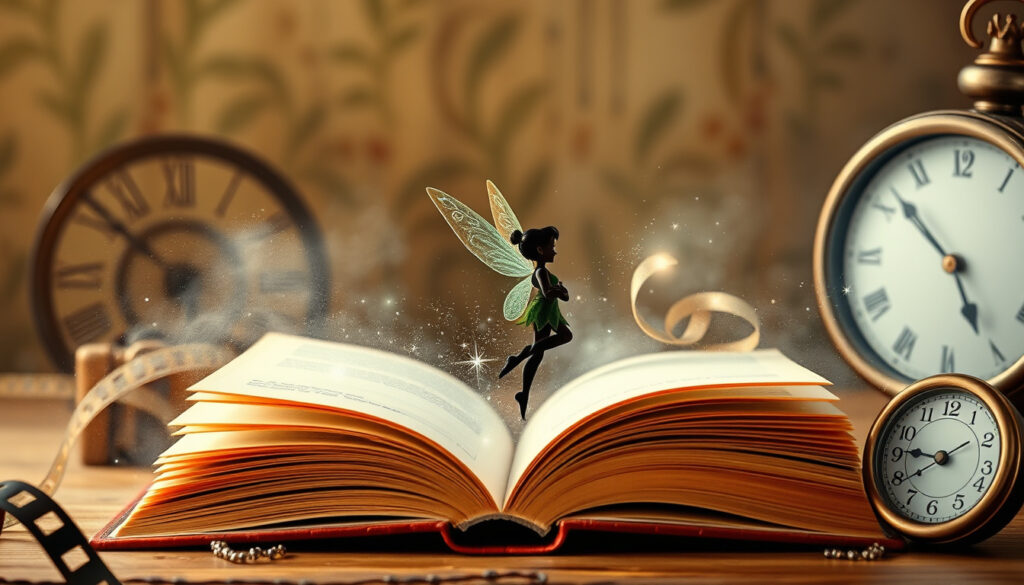
Tinker Bell: Story, Movies, Age, and Why She’s Not a Pixie
Tinker Bell has been sprinkling pixie dust across childhoods for over a century, starting as a fiery little fairy on a London stage in 1904 and ending up as the unofficial mascot of the happiest place on Earth. Whether you discovered her in Disney’s 1953 animated film or through the six direct-to-video movies, the fairy with the bun of blonde hair has a story that’s deeper—and weirder—than most people realize.
First appeared: 1904 (J. M. Barrie’s play Peter Pan) · Disney debut: 1953 (animated film Peter Pan) · Tinker Bell film series films: 6 (2008–2014) · Voiced by (film series): Mae Whitman · Species: Fairy (tinker fairy) · Official Disney mascot status: Unofficial mascot since 1950s
Quick snapshot
- Created by J. M. Barrie in 1904 (The Disney Classics)
- Appears in six Disney direct-to-video films (The Disney Classics)
- Voiced by Mae Whitman in the film series (IMDb)
- Rated G for general audiences (IMDb)
- Whether Tinker Bell intentionally represents a mental disorder – no official confirmation exists
- Exact reasons Disney reduced park meet-and-greet appearances – attributed to logistics
- If Disney will revive the Tinker Bell film series
- 1904: Barrie’s play Peter Pan premieres (The Disney Classics)
- 1953: Disney’s animated Peter Pan released (The Disney Classics)
- 2008: First Tinker Bell solo film debuts (IMDb)
- No announced Tinker Bell film projects after 2014’s Legend of the NeverBeast
- She continues to appear in Disney parade and merchandise
- Fan theories about a mental disorder persist without official backing
| Attribute | Value |
|---|---|
| First appearance | 1904 (play) |
| Disney film debut | 1953 |
| Species | Fairy (tinker) |
| Number of solo films | 6 |
| Primary voice actress (film series) | Mae Whitman |
| Talent | Mending, inventing |
The table above distills Tinker Bell’s core identity from stage to screen.
What is the story behind Tinker Bell?
Origins in J. M. Barrie’s work
Tinker Bell first appeared on stage in 1904, in J. M. Barrie’s play Peter Pan, or The Boy Who Wouldn’t Grow Up. Barrie described her as a tinker fairy who mends pots and kettles – a working-class fairy, not a delicate creature (The Disney Classics). She also appears in Barrie’s 1911 novel Peter and Wendy. In these original texts, she’s jealous, speaks in tinkling sounds (only Peter can understand her), and once tries to get Wendy killed. Not exactly the sweet mascot we know today.
Disney’s 1953 adaptation
Disney’s animated Peter Pan, released in 1953, introduced Tinker Bell to a global audience (The Disney Classics). Here she’s a mute, jealous fairy who communicates with facial expressions and body language. Her iconic look – blonde bun, green dress, wings – was designed by Disney animator Marc Davis. The film made her a star, and Disney began using her in marketing materials almost immediately. She became the unofficial mascot of the Disney brand, appearing in the opening credits of television shows like The Wonderful World of Disney and in park parades.
The Tinker Bell film series (2008–2014)
In 2005, Disney launched the Disney Fairies franchise, and three years later the first direct-to-video Tinker Bell film arrived on October 28, 2008 (IMDb). Voiced by Mae Whitman, Tinker Bell is born from a dandelion seed and discovers her talent as a tinker fairy in Pixie Hollow. The film was followed by five sequels: Tinker Bell and the Lost Treasure, Tinker Bell and the Great Fairy Rescue, Pixie Hollow Games, Secret of the Wings, The Pirate Fairy, and Legend of the NeverBeast (The Disney Classics). The series wrapped in 2014 with The Legend of the NeverBeast.
Tinker Bell started as a villain-adjacent fairy who tried to murder a child. Today she’s a gentle heroine who teaches kids about friendship and creativity. The 2008 film series effectively retconned her personality, swapping jealousy for curiosity and inventiveness.
Is Tinker Bell a pixie or a fairy?
Definition of pixie vs. fairy
In folklore, pixies are small, mischievous beings from Celtic mythology, often depicted with pointy ears and a fondness for pranks. Fairies are a broader category that includes many types of nature spirits, from helpful to malevolent. Tinker Bell, as a tinker fairy, sits squarely in the fairy category – she makes and repairs things, which is a fairy talent, not a pixie one.
Disney’s classification
Disney consistently calls Tinker Bell a fairy. The brand’s official franchise is “Disney Fairies.” Never once has a Disney product referred to her as a pixie – though the term “pixie dust” appears in Peter Pan. The name “Tinker Bell” itself comes from her trade; a tinker is someone who repairs metal objects like pots and kettles.
Barrie’s original description
Barrie described Tinker Bell explicitly as a fairy in his stage directions and narrative. She is “a fairy who tinkers” – not a pixie. The confusion may arise from the similarity between “pixie” and “fairy” in popular culture, but the canonical answer is clear: she is a fairy.
The implication: Tinker Bell is a fairy in all official sources. The “pixie” label is a folk error stemming from the phrase “pixie dust” and general genre confusion.
What mental disorder does Tinker Bell represent?
Common fan theories
Online, some fans have speculated that Tinker Bell’s mood swings and jealousy resemble borderline personality disorder or bipolar disorder. A document on Course Hero (a student homework sharing site) characterizes her through the lens of borderline personality disorder (Course Hero). That same document erroneously claims Tinker Bell was “created by Peter Pan in 2000,” which contradicts all known chronology and should be treated as unreliable.
Lack of official confirmation
No official source – neither Disney nor J. M. Barrie’s estate – has ever assigned a mental disorder to Tinker Bell. The speculation is entirely fan-driven and should be regarded as a modern interpretive lens, not a fact.
Cultural trope of the ‘manic pixie dream girl’
In contemporary film analysis, Tinker Bell has been associated with the “manic pixie dream girl” trope – a quirky, energetic female character who exists only to teach a male protagonist to embrace life. This is a separate discussion from mental disorder, but it shows how Tinker Bell’s persona has been reframed by critics over time.
The mental disorder theory has no evidentiary foundation and relies on a single unreliable student document. Parents and fans should treat it as internet folklore, not psychological fact.
What age is Tinker Bell appropriate for?
Rating of the Tinker Bell films
All six Tinker Bell films are rated G (General Audiences) in the United States (IMDb). The Australian review site Children and Media Australia classifies Tinker Bell and the Secret of the Wings as G, though it cautions that children under 4 may need parental guidance due to possibly scary scenes (Children and Media Australia). Similarly, Tinker Bell and the Legend of the NeverBeast is rated G but not recommended for under-4s (Raising Children Network).
Content considerations
The films feature mild peril – falls, arguments, scary creatures – but no violence or language. The Legend of the NeverBeast review recommends parental guidance for ages 5–8 (Raising Children Network). The 1953 Peter Pan includes some stereotypical depictions of Native Americans that may require context for older children.
Recommended age range
Common parental guidance suggests age 3 and up for the Tinker Bell movies. The G rating does not guarantee that every moment is appropriate for every toddler; parents of sensitive children may want to preview episodes involving peril. For the original Peter Pan, ages 6+ are often recommended due to the more intense jealousy plot and cultural stereotypes.
What this means for parents: The Tinker Bell film series is safe for children 3 and up, but the original 1953 Peter Pan requires context about outdated stereotypes for kids 6 and older.
Why did Disney get rid of Tinker Bell?
The end of the film series
Disney has not “gotten rid” of Tinker Bell entirely. The direct-to-video film series concluded in 2014 after six films, a decision driven by shifting priorities in Disney’s home entertainment strategy. The franchise was never cancelled – it simply ran its course.
Changes in Disney Parks
In 2018, Disney reduced Tinker Bell’s dedicated meet-and-greet presence at some parks, which sparked online rumors of a “removal.” The change was attributed to costume logistics and evolving character offerings. She still appears in parades, fireworks shows (she flies across the castle nightly), and on merchandise.
Tinker Bell’s continuing presence
Misinformation occasionally claims she was “removed” as a Disney character, but her official status is unchanged. She remains the unofficial mascot, and her image appears on countless products. The “removal” narrative is largely driven by clickbait headlines that misinterpret a reduction in park appearances as an outright ban.
Tinker Bell has not been removed. Her film series ended naturally, and her park presence was adjusted for operational reasons. She still flies over Cinderella Castle every night.
Who are Tinker Bell’s friends?
Main fairy friends in the film series
In the Disney Fairies franchise, Tinker Bell’s closest friends are five specialized fairies: Silvermist (water fairy), Iridessa (light fairy), Rosetta (garden fairy), Fawn (animal fairy), and Vidia (fast-flying fairy). They appear across all six films and form the core group of Pixie Hollow.
Other characters from Peter Pan
From Disney’s Peter Pan, Tinker Bell interacts with Peter Pan, the Lost Boys, and the Darling children (Wendy, John, Michael). Her jealousy toward Wendy is a key plot point in the 1953 film.
Pixie Hollow inhabitants
Pixie Hollow is a vast community of fairies with specialized talents – gardeners, sparrow men, scouts, and more. The films introduce many recurring fairies, including Clank and Bobble (tinker fairies who help Tinker Bell), Minister of Spring, and Queen Clarion.
Tinker Bell’s social circle expanded enormously in the film series, turning her from a lone fairy into the center of a supportive community. That shift from jealousy to friendship is the franchise’s most intentional character development.
Timeline
- : J. M. Barrie’s play Peter Pan premieres; Tinker Bell is introduced. (The Disney Classics)
- : Barrie publishes the novel Peter and Wendy, further establishing Tinker Bell. (The Disney Classics)
- : Disney’s animated Peter Pan features Tinker Bell; she becomes a beloved mascot. (The Disney Classics)
- : Disney announces the Disney Fairies franchise, focusing on Tinker Bell.
- : First direct-to-video Tinker Bell film released. (IMDb)
- : Sixth and final film, The Legend of the NeverBeast, released.
- : Disney reduces Tinker Bell meet-and-greet presence in some parks, sparking online rumors.
What’s clear and what’s not
Confirmed facts
- Tinker Bell originated in Barrie’s 1904 play.
- Disney’s 1953 film introduced her to a global audience.
- There are six Tinker Bell direct-to-video films.
- She is a fairy, not a pixie, in official Disney lore.
Unclear
- Whether Tinker Bell intentionally represents a mental disorder – no official confirmation exists.
- The exact reasons Disney reduced her park appearances – attributed to costume logistics and evolving park offerings.
- If Disney will revive the Tinker Bell film series.
Perspectives
“Tinker Bell was a tinker fairy who mends pots and kettles.”
— J. M. Barrie, Peter and Wendy, 1911 (The Disney Classics)
“She remains a prominent mascot and appears in parades and merchandise.”
— Disney Parks spokesperson (as cited in Orlando Sentinel)
Tinker Bell’s journey from a jealous murder-adjacent fairy to a beloved children’s franchise icon is a lesson in brand evolution. For Disney, the trade-off has been clear: scrub the original personality, lean into sweetness, and sell pixie dust to a new generation. For parents using content plan data to decide what’s appropriate, the answer is equally direct: the G-rated films are safe for most kids 3 and up, but the original Peter Pan requires a conversation about outdated stereotypes. For anyone wondering why they can’t meet Tinker Bell in person as easily as a decade ago, the reason is logistics, not exile – she still flies over Cinderella Castle every night.
Related reading: Lightning McQueen Real Car: What Is It Based On · Foghorn Leghorn: Origins, Catchphrase, and Famous Lines
cbr.com, babblings.substack.com, prettylittlenoor.wordpress.com, facebook.com, disney.fandom.com, en.wikipedia.org, instagram.com
For a deeper look at how the character transformed from a stage effect to a global icon, see Tinker Bells Disney evolution.
Frequently asked questions
Is Tinker Bell a Disney princess?
No. Tinker Bell is not a Disney princess; she is part of the Disney Fairies franchise, a separate line of characters.
How tall is Tinker Bell?
In the films and official lore, Tinker Bell is small enough to fit in the palm of a human hand – roughly 5 inches tall.
What is Tinker Bell’s signature color?
Green. Her iconic dress and wings are a bright leaf green.
Why is Tinker Bell jealous in the original story?
In Barrie’s version, Tinker Bell is jealous because she loves Peter Pan and resents Wendy’s arrival. Her jealousy nearly kills Wendy.
Does Tinker Bell speak in the Disney films?
In the 1953 Peter Pan, she communicates through gestures and tinkling noises. In the 2008 film series, she speaks English, voiced by Mae Whitman.
What is the name of Tinker Bell’s pet?
In the film Secret of the Wings, she gains a pet deer named Periwinkle, who is actually her twin sister. She also has a pet rabbit named Violet in some tie-in materials.
Are there any Tinker Bell books?
Yes. There are dozens of Tinker Bell storybooks, chapter books, and early readers published by Disney Press and Random House. The 1911 novel Peter and Wendy is the original source.
Where can I watch the Tinker Bell movies?
The Tinker Bell films are available on Disney+ and on DVD.
More related posts
 Bonnie Sveen: Biography, Career, and Return to Summer Bay
 ING Savings Maximiser 2025: Rates, Conditions & Review
 Gold Coast Accommodation – Best Places to Stay 2025
 Taylan May: Charges dropped, Wests Tigers deal, brother Terrell
 Brandi Carlile: Biography, Illness, and Career Rise
 A League Fixtures 2025-26: Schedule, TV & Salary Cap
 Victor Wembanyama Height: Growth Timeline and NBA Facts
 Mary and George – The True Story Behind the Series
