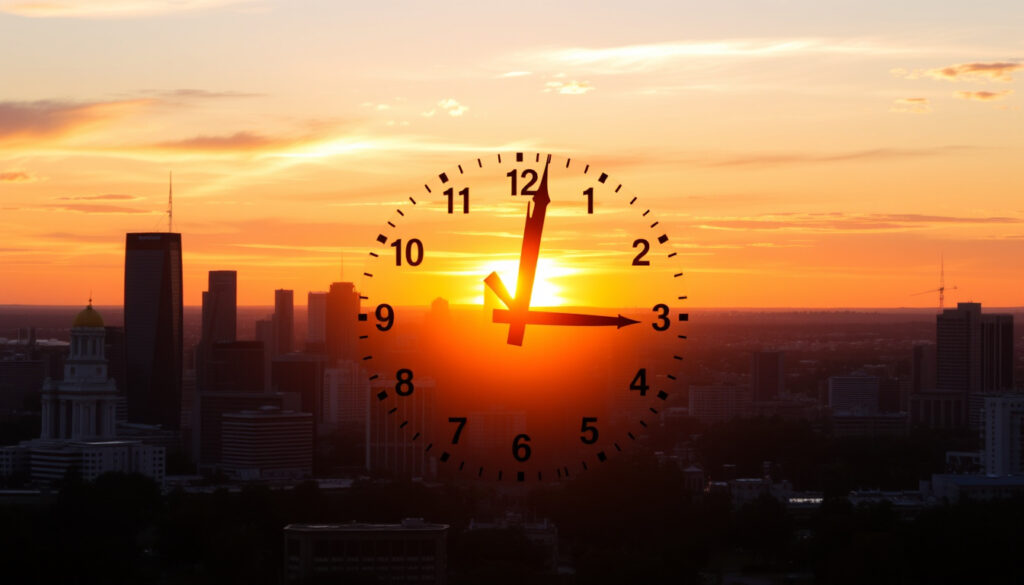
Daylight Saving Victoria 2026: Clocks Change Dates & Tips
Few annual events divide Australians quite like the clock change. For Victorians, the biannual switch to daylight saving means longer evenings in spring and a precious extra hour in autumn — but it also disrupts sleep schedules and catches many off guard, making this guide essential for 2026 planning.
Daylight saving start in Victoria 2026: Sunday, 4 October 2026 at 2:00 am AEST ·
Daylight saving end in Victoria 2026: Sunday, 5 April 2026 at 3:00 am AEDT ·
Time zone after start: Australian Eastern Daylight Time (AEDT, UTC +11) ·
Time zone before start: Australian Eastern Standard Time (AEST, UTC +10) ·
Duration of daylight saving in Victoria: 6 months (first Sunday in October to first Sunday in April) ·
Sleep impact: extra hour in autumn: Yes – clocks fall back, granting one extra hour of sleep
Quick snapshot
- Daylight saving starts on 4 October 2026 at 2:00 am AEST (Business Victoria, Victorian Government business support agency)
- Daylight saving ends on 5 April 2026 at 3:00 am AEDT (Reserve Bank of Australia, Australia’s central bank)
- Clocks shift one hour in both directions (NRMA, motoring and lifestyle organisation)
- Victoria has observed DST under this schedule since 2008–09 (Wikipedia, collaborative encyclopedia)
- No future legislative changes to the schedule have been announced as of 2025 (Business Victoria)
- Individual impacts on sleep and productivity vary; long-term health effects remain debated (Sleep Health Foundation, national sleep charity)
- 1917 – Victoria first observes DST during WWI (Wikipedia)
- 1942–1944 – Temporary DST during WWII (Wikipedia)
- 2008–09 – Modern schedule set: first Sunday in October to first Sunday in April (Wikipedia)
- 4 October 2026 – DST starts (clocks forward) (Reserve Bank of Australia)
- 5 April 2026 – DST ends (clocks back) (Reserve Bank of Australia)
- After 5 April 2026, Victoria stays on AEST until 4 October 2026 (Travel Victoria, tourism resource)
- Next DST change after October 2026: ends on 4 April 2027 (Travel Victoria)
Five key facts capture the essential pattern of Victoria’s daylight saving: the official rules, the legislation behind them, and how the state compares with others across Australia.
| Fact | Value |
|---|---|
| Official start rule | First Sunday in October, 2:00 am AEST |
| Official end rule | First Sunday in April, 3:00 am AEDT |
| Legislation | Victorian government under the Standard Time Act 2005 (amended) |
| Observing areas | All of Victoria (statewide) |
| Non-observing states | Queensland, Western Australia, Northern Territory |
Do clocks go forward or back in Victoria?
Which direction in October (spring)?
- In October, clocks spring forward one hour at 2:00 am AEST, becoming 3:00 am AEDT (Business Victoria, Victorian Government business support agency)
Which direction in April (autumn)?
- In April, clocks fall back one hour at 3:00 am AEDT, returning to 2:00 am AEST (Reserve Bank of Australia, Australia’s central bank)
The ‘spring forward, fall back’ rhyme helps Victorians remember the direction: lose an hour in October, gain one in April.
When does daylight saving start and end in Victoria?
Daylight saving start 2026
- Starts Sunday 4 October 2026 at 2:00 am AEST, when clocks move forward to 3:00 am AEDT (Reserve Bank of Australia)
Daylight saving end 2026
- Ends Sunday 5 April 2026 at 3:00 am AEDT, when clocks move back to 2:00 am AEST (Reserve Bank of Australia)
- Note: 5 April 2026 also falls on Easter Sunday (NRMA, motoring and lifestyle organisation)
Recurring schedule rule
- The first Sunday in October is the recurring start date; the first Sunday in April is the end date (Business Victoria)
- This gives a consistent 6-month period every year.
Do we gain or lose an hour?
Gain an hour in autumn
- When clocks fall back in April, you gain one hour of time – often described as an extra hour of sleep (Sleep Health Foundation, national sleep charity)
Lose an hour in spring
- When clocks spring forward in October, you lose one hour – wake up feeling shorter on rest (Sleep Health Foundation)
Impact on sleep schedule
- The Sleep Health Foundation recommends gradually adjusting bedtime by 15 minutes earlier for three days before the October change, and by 15 minutes later for three days before the April change (Sleep Health Foundation)
- Exposure to morning light immediately after waking helps reset your internal clock.
The spring transition can disrupt sleep for up to a week. The Sleep Health Foundation advises Victorians to plan ahead – especially those with young children or shift work.
Is it daylight saving in Melbourne right now?
How to check current DST status
- Melbourne observes daylight saving from October to April; outside that period it uses AEST (timeanddate.com, world clock and time zone reference)
- For real-time confirmation, check timeanddate.com or the World Clock.
Current time in Melbourne (AEST/AEDT)
- During DST: Australian Eastern Daylight Time (AEDT, UTC+11) (Travel Victoria, tourism resource)
- Outside DST: Australian Eastern Standard Time (AEST, UTC+10) (Travel Victoria)
The pattern: whether you need to check the current time or plan a call, knowing whether DST is active prevents confusion.
What is the history of daylight saving in Victoria?
First introduction
- Victoria first observed daylight saving in 1917 as a wartime measure during World War I (Wikipedia, collaborative encyclopedia)
- A second temporary period occurred from 1942 to 1944 during World War II (Wikipedia)
Modern adoption from 2008–09
- The current fixed schedule (first Sunday in October to first Sunday in April) began in 2008–09 (Wikipedia)
Comparison with other Australian states
- Victoria follows the same schedule as New South Wales, the Australian Capital Territory, South Australia, and Tasmania (Reserve Bank of Australia, Australia’s central bank)
- Queensland, the Northern Territory, and Western Australia do not observe daylight saving (Reserve Bank of Australia)
Timeline of daylight saving in Victoria
- 1917 – First observance during WWI (Wikipedia)
- 1942–1944 – Temporary observance during WWII (Wikipedia)
- 2008–09 – Modern schedule set: first Sunday October to first Sunday April (Wikipedia)
- 4 October 2026 – DST starts (clocks forward) (Reserve Bank of Australia)
- 5 April 2026 – DST ends (clocks back) (Reserve Bank of Australia)
The catch: despite its long history, the debate over whether DST still serves its purpose continues, making future legislation unpredictable.
Confirmed facts and what’s unclear
- Confirmed: Daylight saving start and end dates for 2026 are published by Business Victoria and the Reserve Bank of Australia.
- Confirmed: Clocks shift one hour in both directions.
- Confirmed: Victoria has observed DST annually since 2008–09.
- Unclear: Any future legislative changes to the schedule are not scheduled as of 2025.
What this means: residents can rely on the current schedule for now, but should watch for official announcements.
Expert perspectives
Daylight saving time in Victoria begins on the first Sunday in October at 2:00 am AEST and ends on the first Sunday in April at 3:00 am AEDT.
Business Victoria, Victorian Government business support agency
Adjust your sleep gradually in the days leading up to the clock change; expose yourself to morning light to help reset your circadian rhythm.
Victoria’s modern daylight saving schedule was adopted in 2008–09, standardising the first Sunday in October start and first Sunday in April end.
Wikipedia, collaborative encyclopedia
For Victorians, the trade-off is clear: longer summer evenings and a potential week of sleep disruption each October. Planning ahead with gradual bedtime adjustments and morning light exposure can ease the transition. The official dates are locked in for 2026, but the debate over whether daylight saving still serves its purpose continues – and only future legislation will tell.
Frequently asked questions
Does all of Australia observe daylight saving?
No. Queensland, the Northern Territory, and Western Australia do not observe daylight saving. Victoria, NSW, ACT, South Australia, and Tasmania do (Reserve Bank of Australia).
Why does Victoria have daylight saving?
Daylight saving was introduced to extend daylight hours in the evening during warmer months, originally as a wartime measure and later as a permanent schedule from 2008–09.
How can I adjust my sleep schedule before the time change?
The Sleep Health Foundation recommends adjusting your bedtime by 15 minutes earlier for three days before the October change and 15 minutes later for the April change, along with morning light exposure.
What is the purpose of daylight saving?
The primary purpose is to make better use of daylight by shifting clocks forward in spring so that evenings have more daylight, and back in autumn to return to standard time.
When does daylight saving end in 2027?
Daylight saving in Victoria ends on Sunday 4 April 2027 for the 2026–27 period (Travel Victoria).
Does Victoria, BC in Canada have daylight saving?
This article covers Victoria, Australia. For Victoria, British Columbia (Canada), daylight saving rules differ – consult local Canadian authorities.
How to set clocks on smart devices automatically?
Most modern smartphones, computers, and smart home devices automatically adjust for daylight saving if their time zone is set to Melbourne/Australia. Check your device settings to ensure automatic DST adjustment is enabled.
The implication: these common questions address the most frequent confusions about DST in Victoria.
Related reading
More related posts
 Madhuri Dixit Personal Life: Marriage, Children & Career Timeline
 Viennetta Ice Cream Comeback: Is It Still Available
 Johnny Ruffo: Brain Cancer Symptoms and Legacy
 Brigitte Macron: Age, Children, Marriage, and Controversies
 CatDog: What It Is, Why Canceled, and Hybrid Reality
 Garry McDonald: Biography, Norman Gunston & Mental Health
 Alex Caruso: Hair Loss, Ethnicity, Lakers Trade & More
 Coronation Street 2026: Cast Exits, Spoilers & New Schedule
