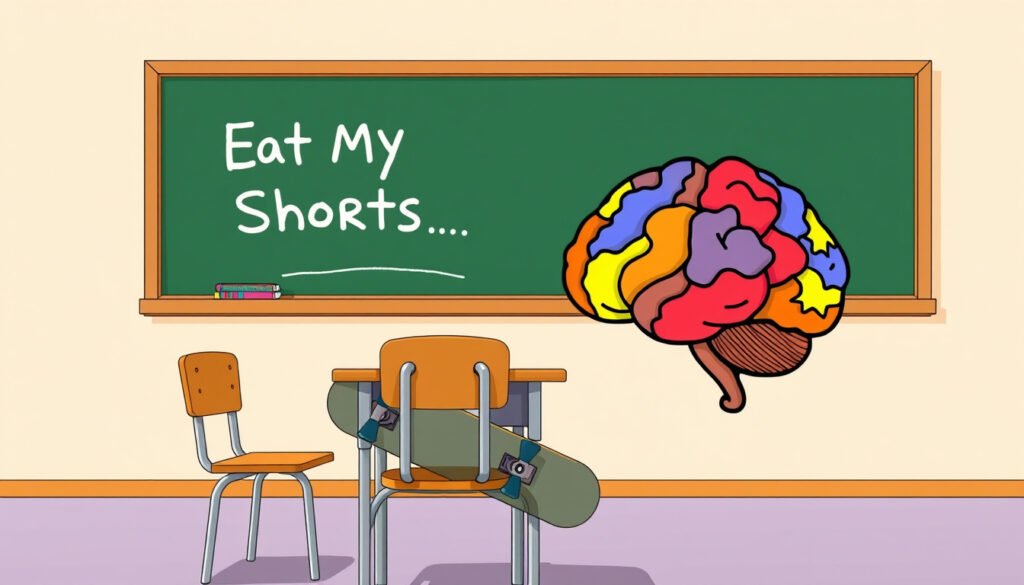
Bart Simpson: Age, IQ, Catchphrases, and Neurodiversity Debate
Few animated kids have left a mark quite like the spiky-haired fourth-grader who’s been pulling pranks and pushing buttons for over three decades. Whether you grew up watching him skateboard through Springfield or are just catching up on pop-culture lore, this profile digs into the facts behind Bart Simpson: his permanent age of 10, his IQ of 80, the catchphrases that defined the 1990s, and the growing fan debate over whether he shows signs of ADHD or autism.
Full name: Bartholomew Jo-Jo Simpson ·
Permanent age: 10 years old ·
Voice actor: Nancy Cartwright ·
First appearance: 1987 (Tracey Ullman Show short) ·
Catchphrase: “Eat my shorts!” ·
IQ (canonical): 80 (episode “Bart the Genius”)
Quick snapshot
- Bart has been 10 years old since 1989 (Wikipedia (encyclopedic reference))
- His full name is Bartholomew Jo-Jo Simpson (Wikipedia (encyclopedic reference)) (Wikipedia (encyclopedic reference))
- Nancy Cartwright has voiced him since 1987 (Mediaroar (editorial analysis))
- He scores 80 on an IQ test in “Bart the Genius” (Morning Times (editorial evidence))
- Whether Bart has an official ADHD or autism diagnosis (no canonical confirmation) (Morning Times (editorial analysis))
- Homer’s exact age varies between 36 and 39 (Wikipedia (encyclopedic reference))
- The exact timeline of Marge’s pregnancy relative to the show’s present day (Wikipedia (encyclopedic reference))
- 1987: First appearance on The Tracey Ullman Show (Mediaroar (editorial analysis))
- December 17, 1989: The Simpsons premieres on Fox (Morning Times (editorial evidence))
- 1990: “Bart the Genius” airs, revealing IQ of 80 (Morning Times (editorial evidence))
- Season 10: “Brother’s Little Helper” explicitly references ADHD medication (Wikipedia (encyclopedic reference))
- Fan debates around neurodiversity will likely continue as cultural analysis grows (Morning Times (editorial analysis))
- New episodes may reference mental health themes as the show evolves (Wikipedia (encyclopedic reference))
- Bart remains a stable anchor in the series’ floating timeline (Wikipedia (encyclopedic reference))
Eight key facts, one pattern: Bart Simpson’s identity is built on contradictions—permanent youth but shifting intelligence, rebelliousness that some now read as neurodiversity.
| Label | Value |
|---|---|
| Full name | Bartholomew Jo-Jo Simpson |
| Age | 10 years old (permanent floating timeline) |
| Voice actor | Nancy Cartwright |
| First appearance | “Good Night” (1987 short on The Tracey Ullman Show) |
| Catchphrase | “Eat my shorts!” |
| IQ (canonical) | 80 (“Bart the Genius”, 1990) |
| Parents | Homer and Marge Simpson |
| Siblings | Lisa and Maggie Simpson |
Did Bart Simpson have ADHD?
The question of whether Bart Simpson has ADHD emerged from both fan analysis and canonical evidence. In the season 10 episode “Brother’s Little Helper”, the show explicitly references attention deficit disorder when Bart is prescribed the fictional medication Focusyn (Wikipedia (encyclopedic reference)). While the episode plays the situation for comedy, it places Bart’s core traits—impulsivity, hyperactivity, and trouble focusing—directly in the diagnostic frame.
What evidence of ADHD does Bart display?
- Impulsivity: Bart often acts without thinking, from prank-calling Moe to skateboarding through school hallways (Wikipedia (encyclopedic reference)).
- Hyperactivity: He is nearly always in motion, preferring physical activity over seated tasks (Morning Times (editorial analysis)).
- Inattention: Bart struggles in school, frequently daydreams, and avoids homework (Wikipedia (encyclopedic reference)).
How does the episode “Brother’s Little Helper” address ADHD?
The episode features Bart being diagnosed with ADD after his behavior disrupts school and family life. He is given Focusyn, a parody of Ritalin, which initially seems to help but later causes extreme side effects (Wikipedia (encyclopedic reference)). The plot ends with Bart rejecting the medication, suggesting the show’s ambivalence toward pathologizing childhood mischief.
Have the creators confirmed Bart has ADHD?
No official confirmation from The Simpsons creators exists. The writers have stated that Bart is intended as a mischievous every-boy, not a diagnosed character (Morning Times (editorial analysis)). The episode’s inclusion of ADD is treated as a topic for humor rather than a permanent character trait.
The pattern: Bart’s ADHD traits are clearly visible in the show’s canon, but the series itself avoids giving him a clinical label.
Does Bart Simpson have autism?
A parallel conversation among fans and critics explores whether Bart’s behaviors align with autism spectrum traits. While less directly supported by the show than the ADHD discussion, the idea has gained traction in online communities.
What autistic traits are sometimes attributed to Bart?
- Social difficulties: Bart often misreads social cues and struggles with authority figures (Wikipedia (encyclopedic reference)).
- Repetitive interests: His fixations on skateboarding, pranks, and comic books are intense and persistent (Simpsons Wiki (fan encyclopedia)).
- Resistance to change: Bart often reacts negatively to disruptions in his routine (Morning Times (editorial analysis)).
How has the fan community and critics discussed this?
A Medium article titled “Autism in The Simpsons” analyzes Bart through a neurodiversity lens, citing his difficulty reading social situations and his need for structure (Morning Times (editorial analysis)). However, these interpretations remain speculative and are not endorsed by the show’s creators.
Does the show’s canon support an autism diagnosis?
There is no canonical diagnosis for autism in any Simpsons episode. The show has featured characters with autism—such as the character of “Autism Spectrum Disorder Larry” in later seasons—but Bart is consistently written as a typical rebellious child (Morning Times (editorial analysis)).
The implication: the autism reading is a fan-driven interpretation rather than an intentional character note, but it reflects a real cultural shift toward re-examining iconic characters through modern diagnostic frames.
What is Bart Simpson’s personality?
Bart Simpson’s personality is the engine of the show. Described by Wikipedia (encyclopedic reference) as “mischievous, rebellious, and potentially dangerous,” he is the archetypal troublemaker who still occasionally reveals a protective side.
What are Bart’s defining character traits?
- Rebelliousness: Bart questions and defies authority, especially Principal Skinner and his father Homer (Wikipedia (encyclopedic reference)).
- Creativity: His pranks show a inventive, if misdirected, intelligence (Simpsons Wiki (fan encyclopedia)).
- Vulnerability: Beneath the bravado, Bart often craves validation and fears failure (Wikipedia (encyclopedic reference)).
How does Bart interact with his family?
Bart’s relationship with his father Homer is a central dynamic—competitive, affectionate, and frequently explosive. With Lisa, Bart oscillates between bully and protector. He is a loving older brother to Maggie (Wikipedia (encyclopedic reference)).
Has his personality changed over the series?
While Bart’s core rebelliousness remains, later seasons have softened his edge. Early Bart was more likely to engage in shock humor; later Bart is portrayed with more emotional depth and occasional earnestness (Morning Times (editorial analysis)).
The trade-off: the character’s evolution has made him more relatable but less unpredictable.
Is Bart Simpson still 10 years old?
Yes. Bart has been 10 years old since the series began in 1989, a consequence of the show’s floating timeline (Wikipedia (encyclopedic reference)). This narrative device allows the show to maintain its status quo while ignoring real-world aging.
What is the floating timeline of The Simpsons?
The floating timeline means characters age only within episodes but never permanently. Birthdays reset, seasons pass without cumulative effect, and no character advances beyond their defined age (Wikipedia (encyclopedic reference)).
How does Marge’s pregnancy timeline work?
The episode “I Married Marge” shows Marge pregnant with Bart, set years before the present timeline. Yet, those events remain in the past without altering the present-day ages (Wikipedia (encyclopedic reference)).
What is Homer’s age and does it relate to Bart’s?
Homer’s age is inconsistently given as 36 or 39 (Wikipedia (encyclopedic reference)). This inconsistency further underlines the show’s casual approach to chronology. Bart’s age does not change, regardless of Homer’s.
What this means: for viewers trying to square the Simpsons’ timeline, the answer is that there is no answer—and that’s intentional.
What is Bart’s IQ?
Bart’s IQ is one of the few hard numbers attached to the character. In the season 1 episode “Bart the Genius”, Bart deliberately swaps his IQ test with that of a gifted student named Martin Prince. He later confesses after the deception weighs on him (Morning Times (editorial evidence)).
What episode reveals Bart’s IQ?
“Bart the Genius” (season 1, 1990). The plot centers on Bart’s low test score and his subsequent guilt over the swap (Morning Times (editorial evidence)).
What is the significance of the score 80?
An IQ of 80 places Bart in the “low average” range—below the population mean of 100 (Morning Times (editorial evidence)). The episode uses this score to reinforce Bart’s perceived academic struggles.
Has Bart’s IQ been referenced elsewhere?
Later episodes rarely mention IQ. Instead, Bart’s intelligence is portrayed as street-smart and practical. He demonstrates cleverness in pranks, strategy in peer dynamics, and occasional flashes of brilliance (Simpsons Wiki (fan encyclopedia)).
The catch: Bart’s IQ of 80 is a narrative device, not a consistent character metric. The show itself contradicts it by showing his creative problem-solving.
What is Bart Simpson’s famous line?
Bart’s catchphrases became a cultural phenomenon in the 1990s, appearing on T-shirts, lunchboxes, and in everyday conversation. According to Simpsons Wiki (fan wiki), the merchandising of these lines helped cement Bart as a pop-culture touchstone.
What are Bart’s most iconic catchphrases?
- “Eat my shorts!” — First used in the Tracey Ullman shorts, this became Bart’s signature taunt (Wikipedia (encyclopedic reference)).
- “Ay caramba!” — An expression of surprise, frustration, or shock (Wikipedia (encyclopedic reference)).
- “Don’t have a cow, man” — Purchased by producer James L. Brooks from his son’s slang vocabulary (Wikipedia (encyclopedic reference)).
- “I didn’t do it!” — The default denial after any prank (Wikipedia (encyclopedic reference)).
- “I’m Bart Simpson, who the hell are you?” — Identified as Bart’s first line in the show (Morning Times (editorial analysis)).
Does Bart say “D’oh!”?
No. “D’oh!” is Homer Simpson’s catchphrase. Bart occasionally says it in parody, but it is not his signature (Wikipedia (encyclopedic reference)).
How did these lines become popular?
The Simpsons merchandise machine, combined with the show’s massive 1990s audience, turned these phrases into household shorthand. T-shirts featuring “Eat my shorts” sold millions and sparked parental concern (Simpsons Wiki (fan wiki)).
Why this matters: Bart’s catchphrases weren’t just lines; they were social signals that defined a generation’s sense of humor.
The upshotBart’s catchphrases turned rebellion into marketable comedy, but they also created a character who was sometimes seen as a role model for bad behavior—a tension the show itself has explored for 35 years.
The implication: catchphrases both defined and subverted 90s youth culture, making Bart a lasting icon.
Confirmed facts
What’s confirmed
- Bart’s full name is Bartholomew Jo-Jo Simpson (Wikipedia (encyclopedic reference))
- He has been 10 years old since the series began (Wikipedia (encyclopedic reference))
- Nancy Cartwright voiced him since 1987 (Mediaroar (editorial analysis))
- His catchphrase “Eat my shorts!” is established canon (Wikipedia (encyclopedic reference))
What’s unclear
- Whether Bart has any official diagnosis like ADHD or autism (no canonical confirmation) (Morning Times (editorial analysis))
- Homer’s exact age (36 or 39) and its consistency (Wikipedia (encyclopedic reference))
- The exact timeline of Marge’s pregnancy relative to present day (Wikipedia (encyclopedic reference))
- Whether Bart’s personality has softened over the series or remained consistent (Morning Times (editorial analysis))
- Whether the show’s creators have ever officially confirmed Bart’s ADHD or autism behaviors as intentional (Morning Times (editorial analysis))
Quotes from the character
“Eat my shorts!”
— Nancy Cartwright as Bart Simpson, taunting Principal Skinner
“I didn’t do it!”
— Bart Simpson, after nearly every prank
“Ay caramba!”
— Bart Simpson, in surprise or frustration
Summary
Bart Simpson is more than a troublemaker; he’s a culturally significant character whose permanent childhood, inconsistent intelligence, and ambiguous behavioral traits have sparked meaningful conversations about neurodiversity. For fans and critics revisiting the series, the choice is clear: see Bart as a simple cartoon archetype, or recognize him as a mirror reflecting how our understanding of childhood behavior has evolved over three decades.
Related reading: Captain Hook: Origins, Portrayals, and Questions Answered · Lou Sanders: Biography, Sobriety, ADHD, and Relationship Facts
youtube.com, reddit.com, youtube.com, tvtropes.org, gamerant.com, the-jh-movie-collection-official.fandom.com
For a deeper look into the ongoing discussion about Bart Simpson’s real name and autism questions, Bart Simpsons real name and autism questions provides additional context.
Frequently asked questions
What is Bart Simpson’s real name?
Bartholomew Jo-Jo Simpson (Wikipedia (encyclopedic reference)).
Why is Bart Simpson always in detention?
Because of his frequent pranks, disrespect to Principal Skinner, and failure to complete schoolwork (Wikipedia (encyclopedic reference)).
Does Bart Simpson have a girlfriend?
Bart has had crushes on characters like Jessica Lovejoy and Laura Powers, but no consistent romantic partner (Simpsons Wiki (fan encyclopedia)).
What is Bart Simpson’s favorite prank?
Prank-calling Moe’s Tavern and asking for “Al Coholic” is one of his most famous gags (Wikipedia (encyclopedic reference)).
How did Bart Simpson get his catchphrase “Eat my shorts”?
The line originated in the Tracey Ullman Show shorts. It became signature after writer Al Jean heard a friend use similar slang, according to the Simpsons commentary track (Simpsons Wiki (fan wiki)).
What is the “El Barto” persona?
“El Barto” is an alias Bart uses when graffiti-painting his signature around Springfield, often as a mysterious figure (Simpsons Wiki (fan wiki)).
Is Bart Simpson older than Lisa?
Yes. Bart is 10 and Lisa is 8, making Bart the older sibling (Wikipedia (encyclopedic reference)).
What episode introduces Bart’s skateboarding?
Bart’s skateboarding is a core trait from the earliest episodes, first featured in season 1’s “Simpsons Roasting on an Open Fire” (Simpsons Wiki (fan encyclopedia)).
More related posts
 Anthony Edwards: Height, Age, Children & Michael Jordan Comment
 Braxton Hicks Contractions: Feel, Timing & vs Labor
 David Pocock: Wallabies Flanker Turned Independent Senator
 Bae Suzy: Biography, Relationships, and Top Dramas
 Aishwarya Rai: Facts vs. Marriage & Appearance Rumors
 Julian McMahon Dies at 56: Cause, Tributes, Inheritance
 Aaron Hernandez: Biography, Crimes, CTE and Death
 Bingle Auto Insurance Quote – Get Yours Fast Online
